Is a Children's Education Franchise a Good Business for Your Market?
Children’s supplementary education can be an attractive business.
But the same educational product may perform very well in one country and face serious difficulties in another.
And the difference is not simply about income levels.
A high-income country is not automatically the best market.
At the same time, a country with relatively modest household income may be highly attractive if it has:
- a large child population;
- parents who actively invest in education;
- affordable operating costs;
- large and growing cities;
- a developing middle class;
- strong demand for supplementary learning.
So before launching a children’s education franchise, the right question is not:
“Is this a wealthy country?”
It is:
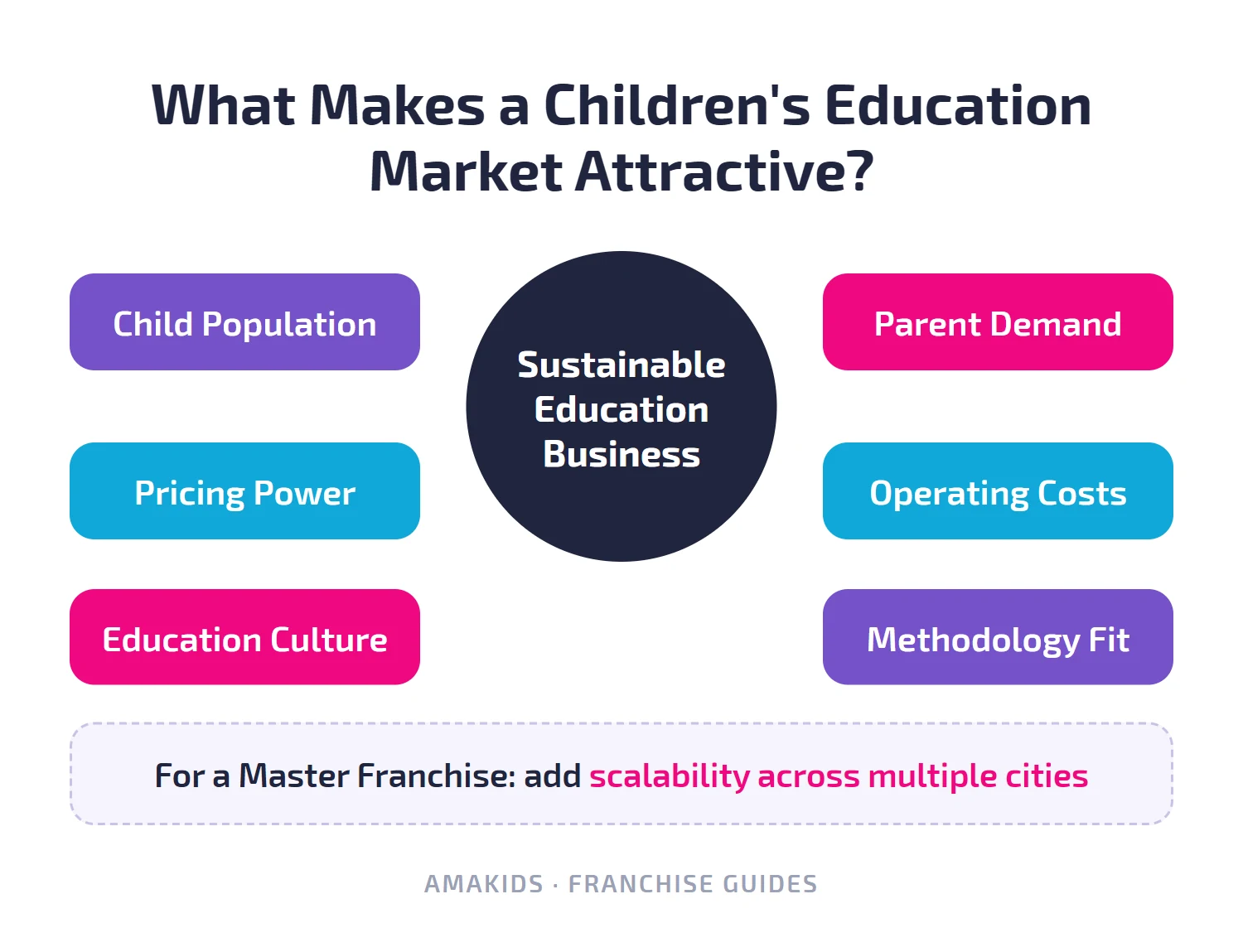
“Do the economics, demographics and education culture of this market fit the business model and methodology?”
What Makes Children's Education Different from Many Other Franchise Businesses?
Education has one important characteristic.
Most of the value is not created by a physical product.
It is created through:
- methodology;
- teachers;
- lesson quality;
- the relationship with the child;
- learning outcomes;
- service for parents.
This means the business is generally less dependent on factors such as:
- imported inventory;
- warehousing;
- international logistics;
- raw material prices;
- transportation of physical goods.
A retail business depends heavily on stock.
A restaurant depends on ingredients, equipment and ongoing purchasing.
In an education center, one of the most important assets is the ability to teach children well, demonstrate progress and retain families over time.
That can make the model relatively flexible.
Price Matters — But Price Alone Does Not Define the Opportunity
Tuition may vary dramatically between countries.
That is normal.
In a high-income market, families may accept a much higher monthly price.
In a lower-income market, tuition usually needs to be lower.
But operating costs may also be significantly lower, including:
- rent;
- teacher salaries;
- marketing;
- administration.
So comparing markets only by tuition can be misleading.
For example:
“Parents pay €150 per month here, but only €40 there.”
That comparison says very little without understanding the rest of the economics.
A center with lower tuition can still be a strong business if it benefits from:
- a much larger child population;
- affordable premises;
- lower staff costs;
- high group occupancy.
And a high tuition price does not automatically mean high profitability if rent and salaries are extremely expensive.
One Advantage of Education Is the Ability to Adapt the Commercial Model
Children’s education businesses usually have some flexibility.
Depending on the market, it may be possible to adjust:
- group size;
- lesson duration;
- lesson frequency;
- packages;
- additional services;
- payment structure;
- delivery format.
One market may support small premium groups.
Another may perform better with larger groups and lower tuition per child.
In one country, parents may prefer monthly subscriptions.
In another, they may be comfortable paying for a term or several months in advance.
An international education model therefore does not always need to copy the same commercial structure in every country.
The methodology and learning outcome should remain protected, while the commercial format can be adapted to local realities.
How Resilient Is Children's Education During Economic Downturns?
It is sometimes said:
“Parents will always spend money on their children.”
That is too absolute.
Any business can be affected by a serious recession.
Families may:
- reduce spending;
- choose cheaper programs;
- cut the number of extracurricular activities;
- move to more affordable formats.
But children’s education has one potential advantage.
For many parents, educational spending is not viewed in the same way as entertainment or discretionary consumption.
It is often seen as an investment in the child’s future.
So when household budgets become tighter, parents may treat education differently from:
- restaurants;
- entertainment;
- new consumer goods;
- other optional purchases.
That can make strong education businesses relatively resilient during economic downturns.
But only if parents see clear value.
During a Crisis, Results Matter Even More
If a program feels like just another children’s activity, cancelling it is easy.
If parents can see:
- progress;
- skill development;
- clear educational value;
- strong engagement from the child;
they may be more likely to continue.
So resilience does not come automatically from operating in the education sector.
It comes from the strength of the product.
A weak education center does not become crisis-resistant simply because it teaches children.
Demographics: Total Population Is Not Enough
One common mistake is to look only at a country’s total population.
For example:
“There are 80 million people here, so the market must be huge.”
For a children’s education business, a better question is:
How many children of the relevant age actually live in the market?
Useful factors include:
- number of children;
- birth trends;
- changes in the child population;
- number of families in major cities;
- population concentration.
A country may have a large total population while its child population is declining.
Another country may be smaller overall but have a much younger population.
Low Birth Rates Do Not Automatically Mean a Poor Market
At first glance, the logic seems obvious:
fewer children → fewer customers → weaker market.
But the economics can be more complex.
When families have one or two children, they may sometimes spend significantly more on each child.
That can include:
- education;
- languages;
- sports;
- tutoring;
- developmental programs.
So a low-birth-rate market may have:
- fewer potential students;
- but much higher spending per student.
That is a different business model.
Not necessarily a worse one.
Emerging Markets Can Offer a Different Type of Opportunity
In emerging markets, the picture may be almost the opposite.
Average household income may be lower.
Tuition therefore needs to be more affordable.
But the market may also offer:
- a large child population;
- rapidly growing cities;
- a young demographic profile;
- lower rent;
- lower staff costs;
- strong parental ambition around education.
For many families, education is seen as one of the main ways to create better opportunities for their children.
Parents may therefore prioritize spending on:
- English;
- mathematics;
- school preparation;
- intellectual development;
- technology;
- supplementary learning.
This can create a very attractive market even at a relatively low average tuition level.
High Revenue per Student and Large Market Size Are Different Models
Consider two simplified markets.
| Factor | Developed Market | Emerging Market |
|---|---|---|
| Number of children | Often lower | Often higher |
| Family income | Higher | Lower |
| Tuition potential | Higher | Lower |
| Rent and salaries | Higher | Often lower |
| Competition | Often stronger | Can be less mature |
| Growth potential | Higher value per student | Higher volume potential |
Both markets can work.
They simply work for different reasons.
That is why the average tuition price alone is not enough to judge whether a country is attractive.
One of the Most Important Factors Is How Parents Think About Education
Demographics and income still do not tell the whole story.
In some countries and cultures, parents invest heavily in supplementary learning.
Children routinely attend:
- language schools;
- mathematics programs;
- sports;
- music;
- exam preparation;
- tutoring;
- after-school education.
In other markets, supplementary education is much less common.
This has a major impact on demand.
The entrepreneur needs to understand:
How natural is it for families in this market to pay for education outside the regular school system?
The Methodology Must Fit the Local Education Culture
There is another factor that can be even more important than economics.
The education methodology itself must fit the way children and parents are prepared to learn.
Mental Arithmetic is a good example.
Results do not depend only on one or two classroom lessons per week.
To develop the skill, a child normally needs regular practice between lessons.
The sessions do not necessarily need to be long.
But they need to be short and consistent.
If the child never practices between lessons, progress may be much slower.
So before launching such a program, the partner should understand:
- whether parents are willing to support regular practice;
- whether children are expected to work independently;
- how families feel about additional exercises;
- whether an app or digital trainer can be used;
- whether the local education culture accepts this type of learning routine.
This can become a critical market filter.
A Commercially Attractive Market May Still Be a Poor Fit for a Specific Methodology
Imagine a country with:
- high household income;
- strong purchasing power;
- parents willing to spend on children.
Commercially, it may look excellent.
But if the local education environment strongly resists regular practice outside formal lessons, a methodology that depends heavily on frequent independent training may struggle.
In other words:
A good market for children's education is not automatically a good market for every education product.
That distinction matters.
Check the Real Rules, Not Assumptions
When evaluating a new country, it is easy to hear statements such as:
“Children are not allowed to receive homework here.”
Claims like this need to be checked carefully.
Restrictions may apply:
- only to public schools;
- only to certain age groups;
- only to mandatory homework;
- only to a particular workload;
- or they may be recommendations rather than legal prohibitions.
Private supplementary education may operate under different rules.
So before rejecting a market, understand the actual legal and practical situation.
The key question is:
Can the program legally and realistically create the level of regular practice required for educational results?
Teachers Are a Core Asset
In many businesses, location or product is the dominant factor.
In education, people matter enormously.
Even a strong methodology can perform poorly with a weak teacher.
A good teacher:
- keeps children engaged;
- explains clearly;
- motivates;
- communicates with parents;
- builds trust;
- helps the child achieve results.
So a market evaluation should also ask:
- Are suitable teachers available?
- What do they cost?
- Can they be trained effectively?
- How stable is the teaching workforce?
- How difficult is replacement hiring?
In some markets, a shortage of strong teachers may be a bigger limitation than a shortage of customers.
A Strong Methodology Reduces Dependence on a “Star Teacher”
This is where a strong education franchise can create real value.
If the system is well standardized, teachers receive:
- lesson structure;
- materials;
- instructions;
- training;
- digital tools;
- quality-control processes;
- home-practice systems.
This reduces dependence on one exceptionally talented teacher.
The teacher still remains extremely important.
But the system helps good teachers deliver consistently good results.
Regulation Can Completely Change the Business Model
Before building the financial model, local rules need to be understood.
For example:
- Is an education license required?
- What premises are allowed?
- Are there qualification requirements for teachers?
- Are there age restrictions?
- What child-safety requirements apply?
- Can programs operate inside existing schools?
- Are evening and weekend classes permitted?
- Are additional approvals required?
Sometimes regulation makes a dedicated center too expensive or complicated.
In that situation, a partnership with an existing school may be more attractive.
Competition Is Not Always a Negative Signal
Entrepreneurs sometimes worry when a market already has many education centers.
But a market with no competition should also raise questions.
If a large city has almost no:
- language schools;
- mathematics centers;
- tutoring;
- after-school programs;
- children’s development centers;
it is important to understand why.
Maybe the market is still open.
But maybe parents simply do not buy these services.
Competition often confirms that demand exists.
The better question is not:
“Are there competitors?”
It is:
“Is there room for another strong education product?”
For Master Franchise, One Strong City Is Not Enough
For a single-center business, evaluating one city or neighborhood may be sufficient.
For a Master Franchise, the question is broader. When a local business is ready to grow into a network is covered in Master Franchise in Children's Education: When a Successful Business Is Ready to Become a Network.
The partner needs to understand:
- how many major cities exist;
- where families are concentrated;
- how many centers could realistically operate;
- which cities should launch first;
- how different regions are;
- whether the model can be repeated.
A country may have one exceptionally strong metropolitan market but limited opportunities elsewhere.
That could still be an excellent market for several centers, but a less attractive market for a large national franchise network.
A Nine-Point Market Check
Before launching a children’s education franchise, I would evaluate at least nine areas.
1. Children
How many children in the relevant age groups live in the market?
2. Demographics
Is the child population growing, stable or declining?
3. Parents
How willing are families to invest in supplementary education?
4. Pricing
What monthly tuition will the market realistically accept?
5. Costs
What do premises, teachers, marketing and administration cost? See How Much Does It Cost to Open a Children's Education Center?
6. Education Culture
How common are after-school programs, tutoring and regular independent practice?
7. Methodology Fit
Does the specific educational product fit local learning habits?
8. Regulation
Can the business model operate without excessive legal or infrastructure costs?
9. Scale
Are there enough cities and potential students to support further expansion?
Once a market looks promising on paper, check it in practice with a small pilot: Open Your Own Education Center or Test the Business Model First?
There Is No Single Ideal Market Type
Very different markets can support successful children’s education businesses.
A Developed Market May Offer
- high tuition potential;
- high spending per child;
- strong purchasing power.
But also:
- fewer children;
- expensive premises;
- higher salaries;
- stronger competition.
An Emerging Market May Offer
- a very large child population;
- growing demand;
- affordable infrastructure;
- strong network potential.
But also:
- lower tuition;
- higher price sensitivity;
- greater need to adapt the commercial model carefully.
Both can work.
The Key Metric Is Not Tuition Price
Ultimately, the economics depend more on the relationship between:
number of students × average revenue per student × retention × cost to operate
than on tuition alone.
That is what determines whether the model works.
Why a Strong Franchise Can Have an Advantage in a New Market
An independent operator has to validate almost everything:
- methodology;
- curriculum;
- teacher training;
- materials;
- technology;
- retention systems;
- operating processes.
A franchise may already provide much of that infrastructure.
The local partner can then focus on a more specific question:
Does this proven education system fit this particular market?
That can reduce the number of unknowns significantly.
But it does not eliminate the need for local validation.
How AMAkids Approaches New Markets
AMAkids works internationally through different partnership formats.
But the decision to develop a territory should not be based only on population size or average income.
The market should be evaluated across several dimensions:
- child population;
- parent behavior;
- tuition potential;
- operating costs;
- teacher availability;
- regulation;
- competition;
- scalability.
And separately, each education program should be evaluated for its fit with local learning culture.
After that, the appropriate format may be selected:
- a dedicated center;
- School Partnership;
- development of a larger territory through Master Franchise.
The Key Question
A strong market for children’s education is not necessarily the wealthiest country.
And it is not necessarily the country with the highest birth rate.
It is a market where several conditions work together:
enough children + parents willing to invest in education + clear educational value + viable center economics + methodology that fits local learning culture.
Sometimes that will be a wealthy developed market with fewer children and high revenue per student.
Sometimes it will be a fast-growing emerging market with millions of children and a much lower average tuition level.
So before launching a children’s education franchise, the right question is not:
“Is this a good country?”
It is:
“Can this specific education model create a sustainable and scalable business in this market?”
Considering an AMAkids partnership in your market? Explore the available partnership models and discuss which format may fit your country, city and business goals.
Explore AMAkids Partnership Models →Considering an AMAkids franchise? Get the partnership presentation: formats, programs and launch support.
Get the presentation