Open Your Own Education Center or Test the Business Model First?
An entrepreneur entering the children’s education market usually faces an important decision very early.
One option is to open a full education center immediately:
- find suitable premises;
- renovate and equip them;
- recruit teachers;
- launch marketing;
- start enrolling students.
The other option is more cautious:
start with a few groups inside an existing school, education center or rented learning space and test the business model before making a larger investment.
At first glance, the second approach may seem obviously safer.
The initial investment is lower, fixed costs are smaller and the entrepreneur can learn faster.
But this model also has risks.
So the real question is not:
“Which option is cheaper?”
It is:
“Which type of risk am I prepared to take first: the financial risk of my own center or the dependency risk of operating inside someone else’s infrastructure?”
Option 1: Open Your Own Education Center from the Start
This is the classic model. For a detailed budget breakdown, see How Much Does It Cost to Open a Children's Education Center?
The entrepreneur builds an independent business and controls:
- premises;
- branding;
- schedules;
- teachers;
- customer relationships;
- marketing;
- programs;
- future expansion.
The main advantage is control.
If the center performs well, there is no need to relocate groups, renegotiate access to classrooms or depend on another business owner.
But this control comes with a higher upfront investment.
What Must Be Funded Before Revenue Becomes Predictable
Typical costs may include:
- rental deposit;
- rent;
- renovation;
- furniture;
- equipment;
- licensing and permits;
- legal costs;
- teacher training;
- initial marketing;
- salaries;
- working capital.
Many of these expenses appear before the entrepreneur knows with confidence:
- how many students will enroll;
- what customer acquisition will cost;
- what tuition level parents will accept;
- which advertising channels will work;
- how quickly groups will fill.
In other words, significant capital is invested before the market provides real answers.
The Main Risk of Opening Immediately: The Cost of Being Wrong
A business plan may look convincing before launch.
But reality may be different.
For example:
- parents may accept a lower price than expected;
- marketing may cost more;
- the location may perform poorly;
- a nearby competitor may become stronger;
- groups may fill more slowly;
- the first teacher may not work out;
- seasonality may be worse than expected.
If the entrepreneur has already invested heavily in renovation and signed a long-term lease, changing direction becomes much more difficult.
This does not mean opening your own center is a bad strategy.
It simply works better when the market is already reasonably well understood.
Option 2: Test the Business on Someone Else’s Premises
Another approach is to delay opening a dedicated center.
Instead, the entrepreneur can negotiate with:
- an existing school;
- an education center;
- a children’s club;
- a language school;
- a private school;
- a coworking or learning space;
- another suitable venue.
If you already own a school or education center yourself, a different scenario applies: Adding a New Program to Your Education Center: Build It Yourself or Use a Franchise?
The entrepreneur only uses the premises when classes are actually running.
For example:
two evenings per week plus Saturday.
Or:
hourly classroom rental.
Or:
revenue sharing.
Or:
a joint program with the venue owner.
This makes it possible to enter the market with much lower fixed costs.
What Can a Pilot Actually Test?
The objective of the first few months does not necessarily have to be high profit.
Sometimes the real value is obtaining reliable answers.
Is There Real Demand?
This is the first question.
Will parents actually enroll their children in the program?
What Price Does the Market Accept?
Estimating tuition is one thing.
Seeing what families are actually prepared to pay is another.
Which Marketing Channels Work?
A pilot can test:
- social media;
- Google;
- local advertising;
- partnerships;
- referrals;
- school presentations;
- events.
How Quickly Can Groups Be Filled?
This has a major impact on the economics of an education business.
Does the Teacher Perform Well?
A strong methodology can still produce poor results if the teacher is not effective with children.
Do Students Stay?
A first enrollment is not enough.
The entrepreneur needs to know whether families continue after:
- one month;
- three months;
- six months.
Does the Educational Product Work in This Market?
Some programs need local adaptation.
Real operating experience reveals what needs to change.
A Pilot Can Be Successful Even If It Makes Almost No Profit
This is an important point.
An entrepreneur may run a pilot for several months and earn very little from it.
That does not automatically make the pilot unsuccessful.
For a relatively small investment, the entrepreneur may discover:
- real student acquisition cost;
- acceptable tuition levels;
- group size;
- retention;
- teacher performance;
- effective advertising channels;
- parent demand.
If this information later supports a decision to open a dedicated center, the pilot has done its job.
The entrepreneur has effectively bought market information rather than short-term profit.
And that information may be much cheaper than learning the same lessons after investing heavily in a full center.
But a Low-Cost Pilot Has a Hidden Price
Operating inside someone else’s premises reduces financial risk.
At the same time, it creates another risk:
dependency on the venue owner.
Imagine an entrepreneur rents a classroom inside an established children’s education center.
They:
- buy a franchise or ready-made education system;
- train a teacher;
- launch advertising;
- build several groups;
- achieve good results.
After several months, the venue owner can see:
- there is real demand;
- children attend;
- parents pay;
- groups are filling;
- the teacher works well;
- the business model is understandable.
At that point, the owner may reasonably ask:
“Why am I renting space to this operator if I could run the same type of program myself?”
What Could the Venue Owner Do?
The venue owner might:
- stop renting the classroom;
- buy a similar franchise;
- purchase the same franchise if territorial rights do not prevent it;
- select another methodology;
- train their own teacher;
- become a direct competitor.
The original entrepreneur may then need to:
- find new premises quickly;
- move existing groups;
- explain the move to parents;
- accept that some students may not follow.
And if the original venue already has a strong local reputation and customer base, competing with it after leaving may be especially difficult.
Sometimes the Entrepreneur May Need to Move to Another Area
Imagine that the entrepreneur has spent six months developing groups inside a large education center.
The pilot proves successful.
The venue then decides to launch the same type of program independently.
The entrepreneur finds their own premises nearby.
But some parents may prefer to stay with the familiar center.
Opening in the same neighborhood may therefore be a poor strategic choice.
The entrepreneur may need to:
- move to another area;
- rebuild local awareness;
- restart part of the marketing process.
So while a pilot can reduce investment risk, it may increase strategic dependency on the host business.
How to Reduce This Risk
It is impossible to remove the risk entirely.
But it can be managed.
The basic rules should be discussed before the first group is launched.
Length of Cooperation
How long is the space guaranteed for?
Notice Period
Can the venue ask the entrepreneur to leave immediately?
Or must it provide several months’ notice?
Customer Data
Who owns the contact information for parents and students?
Payments
Who collects tuition?
Teacher Relationship
Who employs or contracts the teacher?
Can the venue simply hire the teacher directly?
Marketing
Who owns advertising accounts, phone numbers, leads and campaign data?
Competition
Can the venue launch a competing program while the partnership is active?
What Happens at the End?
Who continues working with existing students?
These questions are much easier to resolve when there are no students yet.
Once there are many active groups, the stakes are much higher.
Fixed Rent or Revenue Share?
There are several ways to structure the relationship with the venue.
Fixed Rent
The entrepreneur pays:
- monthly;
- daily;
- or by the hour.
The advantage is predictable cost.
The disadvantage is that rent must be paid even if enrollment is weak.
Revenue Share
Instead of fixed rent, the venue receives a percentage of revenue.
As student numbers grow, the venue earns more.
This can be attractive at the beginning because fixed costs remain lower.
However, the parties need to agree clearly on:
- the percentage;
- what counts as revenue;
- which expenses are deducted;
- who provides the teacher;
- who funds marketing;
- who collects tuition.
Hybrid Model
Another option is:
a small fixed payment + a percentage of revenue.
This can also work well.
When a Pilot Is Especially Useful
A pilot may be particularly valuable when:
- the entrepreneur is entering education for the first time;
- the local market is unfamiliar;
- the country is new;
- there is little experience with local marketing;
- acceptable tuition is unclear;
- demand is uncertain;
- opening a dedicated center requires substantial investment.
In this situation, a few months of real operations may completely change the original business plan.
When Opening Your Own Center Immediately May Make More Sense
A pilot is not always necessary.
A dedicated center may be the better choice if:
- demand is already proven;
- the entrepreneur knows the market well;
- there is an existing customer base;
- the team is ready;
- sufficient capital is available;
- a strong location is available now;
- several programs will be offered;
- the business is intended to operate as a larger center from day one.
In such a case, a temporary venue may simply slow down development.
Another Risk of a Pilot: Growth Can Outrun the Infrastructure
Imagine the pilot works extremely well.
First there are:
2 groups.
Then:
Then:
Suddenly the venue has no more available classrooms.
Or the required time slots are already occupied.
The business is growing, but the infrastructure prevents further expansion.
That is why an entrepreneur should ask before launching:
“What will we do if this pilot succeeds?”
If the answer is:
“Then we will open our own center,”
it is useful to define in advance approximately:
- how many students;
- what level of revenue;
- what group utilization
would justify that move.
A Pilot Should Have a Time Frame and a Purpose
There is another danger: becoming permanently stuck in a temporary model.
Costs are low.
There is some profit.
Moving feels risky.
But growth has stopped.
That is why a pilot should be treated as a validation stage, not automatically as the permanent operating model.
For example:
3–6 months.
During that period, the entrepreneur should learn:
- demand;
- pricing;
- marketing;
- retention;
- teacher performance;
- group economics.
Then make a decision:
stay with the current structure, open a dedicated center, or stop the project.
What Changes When a Franchise Is Used?
A ready-made franchise reduces part of the educational uncertainty. How such a system works in practice: Mental Arithmetic Franchise: How the Business Model Works.
The entrepreneur may already have access to:
- methodology;
- learning materials;
- teacher training;
- platform;
- CRM;
- operating standards.
But a franchise does not automatically answer local business questions:
- Will parents in this city buy the program?
- What tuition level works?
- Which marketing channels work?
- Where should the center be located?
- How easy is it to recruit teachers?
These are exactly the questions a pilot can help answer.
So a franchise and a pilot are not contradictory approaches.
In many cases they can complement each other.
The franchise reduces the need to test the educational product from scratch, while the pilot tests whether the local business model works.
How AMAkids Approaches a New Market Launch
AMAkids works with several partnership formats.
For entrepreneurs who want to open a dedicated center, the relevant model is Single-Unit.
But before making a large investment in an unfamiliar market, it is important to understand whether the financial model is realistic for that specific city.
This is particularly important when the partner:
- has never operated an education business before;
- is entering a new market;
- plans to open several centers later;
- is considering future Master Franchise development.
In some situations, a staged approach may make sense:
ready-made education system → first groups → local demand validation → dedicated center → further expansion.
The exact pilot structure must, however, comply with the franchise agreement, territorial rules and local regulations.
What Should Be Agreed Before Starting a Pilot?
Before the first class begins, the entrepreneur should be able to answer at least these questions:
- Who signs the rental or partnership agreement?
- How long is the space guaranteed for?
- What notice period applies?
- Who owns the customer database?
- Who collects tuition?
- Who pays for marketing?
- Who owns advertising accounts and leads?
- Who employs or contracts the teacher?
- Can the venue launch a competing program?
- Are any territorial protections in place?
- What happens to students if the cooperation ends?
- What result will trigger the move to a dedicated center?
The last question is especially important.
A pilot should test a hypothesis.
It should have success criteria.
How Do You Know When It Is Time to Open Your Own Center?
There is no universal student number.
But the decision becomes much easier once the entrepreneur understands:
- student acquisition cost;
- first-month retention;
- average group occupancy;
- revenue per group;
- realistic number of groups;
- staffing requirements.
At that point, the new center is no longer being opened based mainly on assumptions.
It is being opened based on data.
That is a fundamental difference.
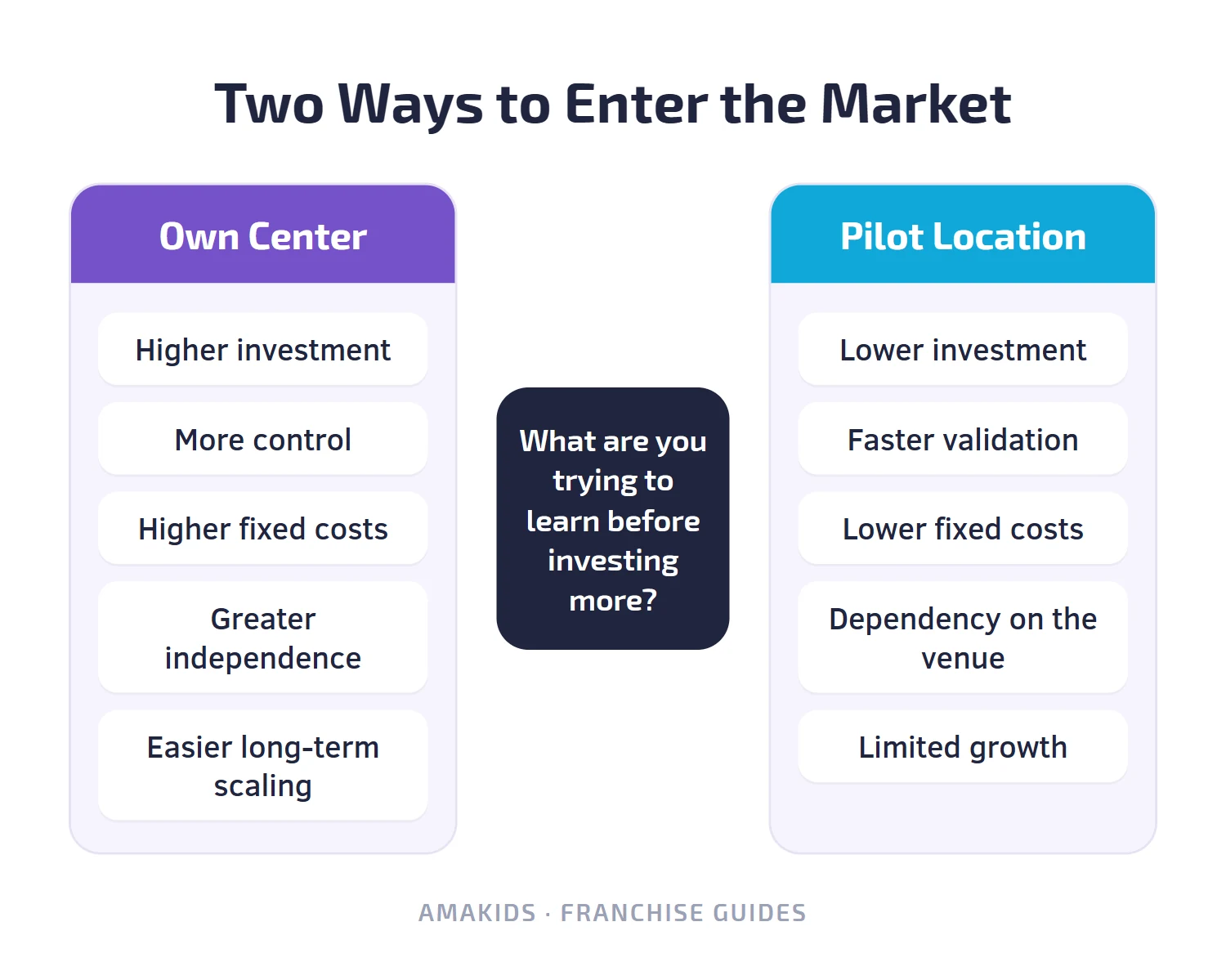
The Real Choice: Capital Risk or Dependency Risk
The two models expose the entrepreneur to different types of risk.
Dedicated Center
More:
- investment;
- fixed costs;
- financial exposure.
But also more:
- control;
- independence;
- room for growth.
Pilot on Someone Else’s Premises
Less:
- initial investment;
- fixed overhead;
- financial pressure.
But more:
- dependency on the venue;
- risk of losing the location;
- risk of creating a future competitor;
- limitations on growth.
Neither model is automatically better.
The Most Expensive Choice Is Not Always the Dedicated Center
The most expensive mistake is not necessarily paying high rent.
The most expensive mistake may be investing heavily before the key assumptions of the business have been tested.
But excessive caution also has a cost.
If an entrepreneur continues operating on someone else’s infrastructure long after demand has been proven, growth may be restricted and the business may become unnecessarily dependent on another owner.
The purpose of a pilot is therefore not to avoid investment forever.
Its purpose is to make the next investment decision with better information.
The Bottom Line
If the entrepreneur understands the market, has sufficient capital, has a capable team and sees clear demand, opening a dedicated center may be the right move from the beginning.
If uncertainty is high, a smaller pilot can provide several months of real operating experience with much lower initial investment.
But the arrangement must be designed carefully so that reducing financial risk does not create excessive dependency on the venue owner.
A good pilot should answer one question:
“Does this business work here?”
After that, the entrepreneur should be ready to make the next decision:
scale it, open a dedicated center, or stop the project.
Planning to launch a children's education business? Explore AMAkids partnership models and choose the format that fits your market and investment strategy.
Explore AMAkids Partnership Models →Considering an AMAkids franchise? Get the partnership presentation: formats, programs and launch support.
Get the presentation