Adding a New Program to Your Education Center: Build It Yourself or Use a Franchise?
An owner of an existing school or education center starts from a very different position than an entrepreneur launching a business from scratch.
You may already have:
- premises;
- teachers;
- administrators;
- students;
- parents;
- schedules;
- marketing channels;
- a local reputation.
So when you want to add a new education program, the main question is usually not:
“How do I open an education center?”
It is:
“How should I add a new product to the education business I already have?”
There are two main paths.
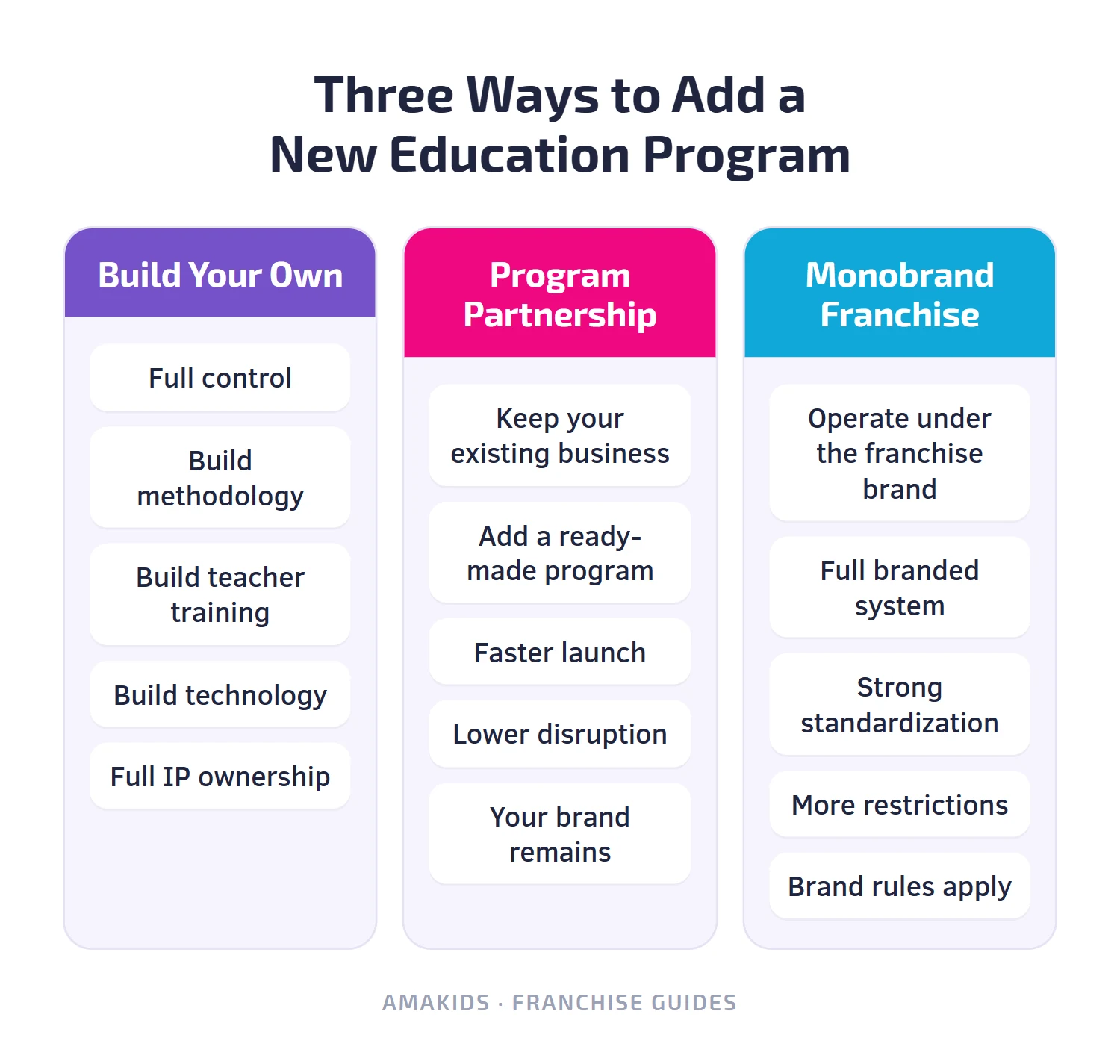
The first is to develop the program independently.
The second is to use an existing system: a franchise, licensed methodology or ready-made education product.
At first glance, building your own program may appear cheaper.
But the right comparison is not simply between the cost of a franchise fee and the cost of a workbook or methodology.
You need to compare the full cost of building the entire system.
Option 1: Build the Program Yourself
Developing your own education product gives you maximum freedom.
You decide:
- what to teach;
- how the curriculum is structured;
- how many levels it has;
- how long the program lasts;
- how lessons are delivered;
- how much tuition costs;
- how the product is branded;
- which materials are used;
- how teachers work with students.
If the program becomes successful, the entire system remains inside your company.
That can be a major advantage.
But there is one important distinction:
Finding a methodology and building a scalable education product are not the same thing.
It may seem easy to:
- download materials;
- buy textbooks;
- find exercises online;
- put together several lessons;
- train one teacher.
That may be enough to start teaching a few groups.
It is usually not enough to build a stable education business.
A Methodology Is Only the Beginning
To operate consistently across multiple groups, you need much more than lesson content.
You need to define:
- the sequence of topics;
- progression criteria;
- the length of each level;
- lesson structure;
- homework;
- assessment rules;
- progress tracking;
- how to support weaker students;
- how to challenge stronger students;
- how new teachers are trained;
- how teaching quality is maintained.
While one strong teacher runs the program, many issues can be solved manually.
When you have five, ten or twenty teachers, quality can vary significantly unless the system is standardized.
At that point, the methodology is no longer just a collection of lessons.
It becomes a system for managing educational quality.
Learning Materials Require Ongoing Maintenance
Even if the first version of the materials is easy to create or purchase, new needs appear over time.
For example:
- materials for different levels;
- corrections and updates;
- additional exercises;
- homework;
- assessments;
- teacher resources;
- updated design;
- local adaptations;
- translations.
This means an independent program requires not only initial development, but continuous maintenance.
Who Will Train New Teachers?
This is one of the most important questions.
Imagine that your school has developed a strong program.
The first teacher is trained directly by the owner or lead methodologist.
Then that teacher leaves.
A replacement must be trained quickly.
Later, you open another location.
Then you hire several more teachers.
Now you need a system for:
- initial training;
- assessment;
- lesson observation;
- feedback;
- certification;
- continued professional development.
Without this structure, the same program may gradually be taught differently in every classroom.
Technology May Cost More Than the Methodology
Parents and teachers increasingly expect more than classroom lessons.
They may expect:
- homework;
- online exercises;
- student statistics;
- parent access;
- progress tracking;
- schedules;
- notifications;
- communication tools.
You can assemble this using multiple third-party services.
For example:
one system for CRM;
another for homework;
another for payments;
another for online lessons;
another for parent communication.
This approach is possible.
But the more tools you use, the more complex operations become.
You may need to:
- duplicate data;
- manually move student information;
- train staff to use multiple systems;
- pay for multiple subscriptions;
- manage integrations and technical problems.
The alternative is to build your own platform.
But that becomes a separate technology business involving developers, product design, testing and ongoing maintenance.
So when comparing an independent program with a franchise, you should consider not only curriculum development, but the entire technology infrastructure behind the product.
Option 2: Use an Existing Education System or Franchise
The alternative is not to build everything from scratch.
A school can integrate an existing education system.
Depending on the franchise or licensing model, it may include:
- curriculum;
- structured programs;
- learning materials;
- teacher training;
- a digital platform;
- homework systems;
- CRM;
- quality-control processes;
- marketing materials;
- launch support.
The main advantage is speed.
Instead of spending months or years developing the system, the school may be able to bring a new product to market much faster.
But a Franchise Does Not Run the Business for You
Some school owners assume:
“If the system is ready, there is nothing else to build.”
That is a mistake.
Even a strong franchise cannot replace local management.
The owner still needs to:
- select the right teacher;
- explain the new program to parents;
- set the schedule;
- define pricing;
- organize sales;
- monitor teaching quality;
- work on student retention.
A franchise provides a system.
The local partner still has to operate it.
The Main Advantage: Less Uncertainty
When the program already works in other centers, some important questions have already been answered.
For example:
- how many levels are needed;
- how the curriculum is structured;
- how teachers are trained;
- which student difficulties are common;
- what materials are required;
- how progress is measured;
- how home practice is organized.
This does not mean the model will automatically work in every country.
But it does mean the school is not starting from a completely blank page.
One Critical Question: Can You Keep Your Existing Brand?
For an established school or education center, this may be one of the most important franchise conditions.
Not all franchises work the same way.
Program Partnership Model
Some franchisors allow the existing school to keep:
- its own name;
- its own brand;
- its existing signage;
- its existing parent communication;
- its current education business.
The school simply adds a new program.
For example, an independent education center may continue operating under its existing brand while adding:
- Mental Arithmetic using a partner methodology;
- English;
- Memory Development;
- other licensed education programs.
For an established education business, this can be a very attractive model.
The owner does not need to abandon the brand they may have spent years developing.
They simply expand the product portfolio.
This is the logic behind a partnership model such as AMAkids School Partnership: an existing education business can retain its own identity while adding selected AMAkids programs.
Monobrand Franchise Model
Other franchise systems require the entire location to operate under the franchisor's brand.
Requirements may include:
- changing the center name;
- using only the franchise brand;
- redesigning the premises;
- using specific signage;
- following a standardized center format;
- limiting other education programs or competing brands.
For a new entrepreneur, this can be perfectly reasonable.
They are creating a new business and can build it around the chosen brand from the beginning.
For an owner who has already spent years building a local school, the situation is very different.
That business may already have:
- a recognized local name;
- reputation;
- a website;
- reviews;
- social media;
- an established customer base.
Giving up that brand can be a much more important decision than the franchise fee itself.
Franchise Models Should Not Be Compared Only by Price
Imagine two franchises.
The first has a lower entry fee but requires:
- full rebranding;
- new signage;
- a standardized design;
- removal of some existing programs.
The second costs more but allows the school to integrate only the new program while keeping its existing brand.
For an established center, the second model may create significantly more value even if the franchise fee is higher.
But the opposite can also be true.
If the owner wants to completely reposition the business and operate under an established international brand, a monobrand franchise may be exactly what they are looking for.
The right question is therefore not:
“Which franchise is cheaper?”
It is:
“How will this franchise coexist with the business I already have?”
What to Check in the Agreement
Before joining a franchise, an existing school should clarify:
- Do we need to change the name of our center?
- Can we continue using our own brand?
- How must the franchisor's brand be displayed?
- Can we continue offering our own programs?
- Can we work with programs from other providers?
- Are competing methodologies restricted?
- Is a separate branded classroom required?
- Does the interior need to be redesigned?
- Can we continue using our existing website?
- How should the program be advertised?
- Under what name is the program presented to parents?
- What happens to the program when the agreement ends?
These questions should be answered before the contract is signed, not after the new program is already running.
What Is Cheaper: Building Your Own Program or Buying a Franchise?
There is no universal answer.
If you compare only the direct payment, building independently may look cheaper.
(If you are also considering a separate location, see How Much Does It Cost to Open a Children's Education Center?)
For example:
“A franchise costs money. I can find a methodology online for free.”
But the next question should be:
What will it cost to turn that methodology into a stable education product?
You need to consider:
- methodologist time;
- curriculum development;
- learning materials;
- teacher training;
- quality control;
- platform;
- CRM;
- technical support;
- marketing materials;
- regular updates;
- management time.
Only then does the comparison become realistic.
The Owner's Time Has a Cost Too
This is often completely ignored.
Imagine the owner spends six months:
- researching the market;
- building the curriculum;
- reviewing materials;
- training teachers;
- solving technical problems.
On paper, they may say:
“I did not pay anything.”
In reality, they spent hundreds of hours.
During that same period, they could have been:
- growing the core business;
- opening another location;
- improving marketing;
- developing the team.
Management time should therefore be included in the comparison.
The Main Advantage of Building Your Own Program
Despite the complexity, an independent education product has a major strength.
If it succeeds, the owner has full control.
They can:
- change the curriculum;
- change pricing;
- adapt materials;
- use their own brand;
- develop the product independently;
- potentially license it to other centers later.
For a strong education company with its own methodology team, this can be a very attractive long-term strategy.
Especially if the company wants to build its own unique intellectual property.
The Main Advantage of a Franchise
A franchise is particularly valuable when the school does not want to create everything from zero.
For example, the school may already have:
- premises;
- students;
- staff;
- marketing.
But may not want to develop:
- a new methodology;
- a platform;
- learning materials;
- a teacher-training system.
In that situation, an existing system allows the owner to focus on launching and selling the new program rather than building the product itself.
Risk of Building Independently: Underestimating the Work
The most common mistake is to estimate only the work required to create the first lessons.
After launch, new tasks appear:
- material updates;
- corrections;
- new levels;
- teacher onboarding;
- parent questions;
- quality control;
- product development.
If the company does not have a methodology team, the program may gradually stop improving.
Risk of a Franchise: Choosing the Wrong System
A ready-made system can also be weak.
A polished brand does not automatically mean a strong education product.
And even a good franchise may simply be the wrong fit for your business.
A practical checklist for comparing systems: How to Choose a Franchise in the Field of Child Development.
For example, the owner may want to keep their school and add one program, while the franchise requires a fully branded monobrand center.
Before joining, check:
- how long the program has been operating;
- how many students have actually used it;
- how the methodology works;
- who trains teachers;
- how frequently materials are updated;
- whether a digital platform exists;
- how well the system can be adapted locally;
- whether your existing brand can remain;
- whether you can continue offering other programs;
- what recurring payments apply;
- what restrictions apply;
- what happens when the agreement ends.
Talking to existing partners can be especially valuable.
Their experience often reveals more about the system than the franchisor's sales presentation.
Can You Buy a Ready-Made Methodology Without Buying a Franchise?
There is also a middle option.
Schools can sometimes purchase:
- textbooks;
- a licensed methodology;
- a standalone course;
- teacher-training materials;
- a digital platform.
So the decision does not always have to be:
“build everything myself”
or
“buy a full franchise.”
Sometimes an education center only needs a specific educational product that it can use under its own brand.
This can be a reasonable compromise.
But the school still needs to understand:
What is included, and what must we build ourselves?
If the provider offers only the methodology, then:
- CRM;
- training;
- marketing;
- quality control;
- home practice;
- support
may still remain the responsibility of the school.
How to Decide
For an existing education center, start with six questions.
1. Do We Have a Strong Methodology Team?
If yes, developing your own product becomes much more realistic.
If not, the project may take far more time than expected.
2. How Quickly Do We Need to Launch?
If the new program needs to be on the market within one or two months, building a complete education system independently may not be realistic.
3. How Important Is Our Existing Brand?
If the school has spent years building its local name, pay particular attention to the difference between:
program partnership
and
monobrand franchise.
4. How Unique Does the Product Need to Be?
If the school wants to create its own intellectual property, independent development becomes more strategically important.
5. What Technology Do We Already Have?
If the school already operates a strong CRM, learning platform and home-practice system, some franchise advantages may matter less.
If none of these exist, a ready-made system can solve several problems at once.
6. Is There Real Demand for the Program?
Even an excellent methodology does not guarantee that parents will buy it.
Regardless of which model you choose, it is sensible to test a new program with a limited number of groups first.
Compare Three Costs, Not One
When making the decision, compare three different costs.
Cost of Buying
How much does the franchise or ready-made system cost?
Cost of Building
How much money and management time will it take to build a similar product internally?
Cost of Being Wrong
What happens if, after a year, you discover that the chosen model was not the right one?
This third cost is often underestimated.
Sometimes a more expensive ready-made system is ultimately cheaper than several years of internal experimentation.
Sometimes the opposite is true: a strong internal team may build its own product more effectively than working within someone else's system.
How AMAkids Works with Existing Schools and Academies
AMAkids offers a separate School Partnership model for education businesses that already have their own infrastructure.
The partner does not necessarily need to convert the entire school into a monobrand AMAkids center.
An existing school or academy can keep its current education business while adding selected AMAkids programs.
Depending on the program and market, the partnership may include:
- methodology;
- learning materials;
- teacher training;
- digital learning platform;
- home-practice tools;
- progress tracking;
- CRM;
- launch support.
For an owner of an existing education center, this is fundamentally different from a traditional monobrand franchise.
The business can expand its educational offering without automatically abandoning the brand and operation it has already built.
Specific brand-use rules and partnership conditions depend on the market and agreement.
Do Not Compare a Franchise with a “Free Methodology”
That is the wrong comparison.
A better comparison is:
a ready-made education system
versus
the full cost of building a comparable system internally.
And when a franchise is involved, there is one more important question:
Will this model require me to rebuild my existing business around another brand, or can I simply add a new product to what already works?
For one school, independent development may be the right strategic choice.
For another, buying a ready-made program may be more efficient.
For a third, the most important factor may be finding a partnership model that allows the school to keep its existing brand.
The final question should therefore not be:
“Should I pay for a franchise?”
It should be:
“Which option will allow my school to launch a strong new program faster and more efficiently, while keeping the right balance between cost, control and independence?”
Already run a school or education center? Explore the AMAkids School Partnership model and see how selected programs can be added to your existing business.
Explore School Partnership →Considering an AMAkids franchise? Get the partnership presentation: formats, programs and launch support.
Get the presentation