How Much Does It Cost to Open a Children's Education Center?
One of the first questions entrepreneurs ask when considering a children’s education business is:
How much does it cost to open an education center?
There is no universal answer.
A small center serving several groups in a regional city, a multi-classroom school in a capital, and a new program launched inside an existing academy are completely different business models with very different cost structures.
More importantly, an initial budget rarely captures everything that can happen during launch.
A location may require additional approvals. Licensing may take longer than expected. An advertising channel that works well in other cities may perform poorly in your market. Renovation may be delayed. Equipment may arrive late. Student recruitment may take longer than planned.
For this reason, the better question is not:
“How much money do I need to open?”
It is:
“Which launch model fits this market, and how much financial reserve do I need if the launch does not go exactly as planned?”
What Determines the Cost of Opening an Education Center?
The budget is usually influenced by several factors:
- country and city;
- business format;
- licensing and regulatory requirements;
- requirements for the premises;
- rent;
- size of the center;
- number of programs;
- size of the initial team;
- student acquisition model;
- whether an existing customer base already exists.
Two education businesses in the same city can therefore require very different levels of investment.
And sometimes, after doing the calculations, the conclusion may be that opening a dedicated center in the original format does not make economic sense at all.
That is not a failed business plan.
It is a useful result.
It is far better to discover this before signing a long-term lease and investing heavily in renovation.
Start by Choosing the Right Launch Model
Before calculating the budget, define what kind of education business you actually want to build.
There are several fundamentally different models.
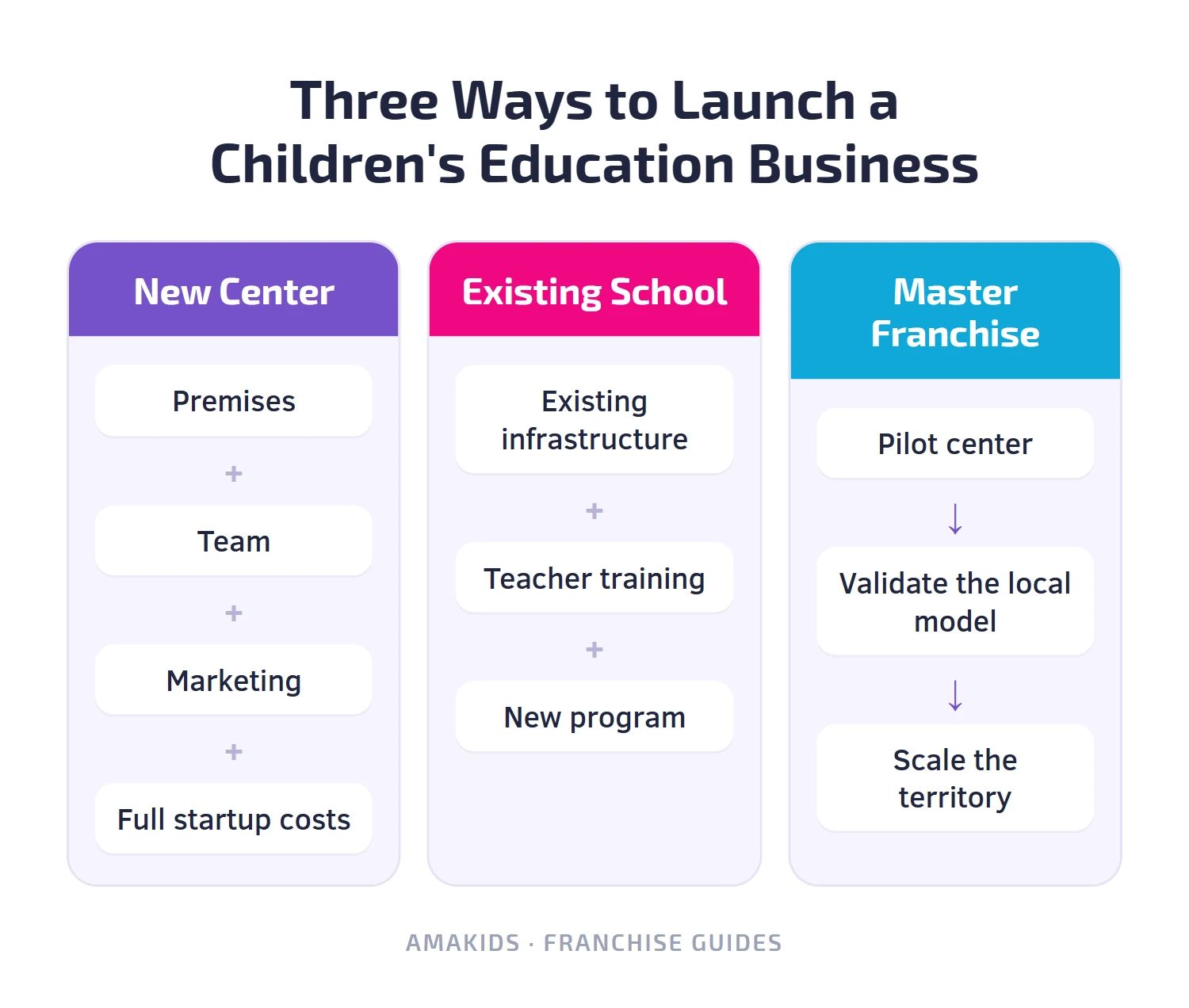
1. Opening a New Education Center from Scratch
This is the most obvious model, but also the most demanding.
If you are coming from outside education, see Opening an Educational Center Without a Teaching Background.
Typically, the entrepreneur needs to:
- find suitable premises;
- confirm that the location can legally be used for educational activities;
- obtain licenses or permits where required;
- prepare classrooms;
- buy furniture and equipment;
- recruit and train teachers;
- launch marketing;
- build administrative processes;
- enroll the first groups of students.
This approach gives the entrepreneur a fully independent center, but it requires more capital, time and management attention.
A new center also starts with almost no customer base.
An existing school may already communicate with hundreds of parents. A new center first has to make local families aware that it exists, build trust, generate interest, attract trial students and only then convert them into long-term customers.
That difference is significant.
2. Adding a New Program to an Existing School or Academy
If an education business is already operating, the situation is very different.
The school or academy may already have:
- premises;
- licenses;
- administration;
- teachers;
- parents;
- students;
- schedules;
- local reputation.
In that case, launching an additional program can be significantly simpler and less expensive.
The main investment may be limited to:
- a new methodology;
- teacher training;
- learning materials;
- software;
- marketing the new program to existing and new customers.
For many entrepreneurs, this can be a lower-risk way to test a new education product.
3. Running Classes Inside an Existing School
In some markets, there is another attractive model.
A school may allow an external education operator to run additional classes after the regular school day.
In that case, it may not be necessary to rent and operate a separate education center.
Several partnership formats are possible.
For example, the education operator may:
- use a school classroom after regular lessons;
- bring in its own teacher;
- train an existing school teacher;
- pay a fixed fee to the school;
- or share revenue with the school.
This model can be highly efficient.
The school already provides:
- premises;
- access to students;
- trust with parents;
- sometimes even a suitable teacher.
An existing teacher may receive additional income and at the same time become someone who already knows the students, understands the school environment and can explain the new program to parents.
In some cases, a revenue-sharing arrangement may be economically more attractive than paying separate rent.
However, whether this model is possible always depends on local regulations, school policy and the legal framework for supplementary education.
4. Developing a Territory or Master Franchise
A completely different situation arises when the partner plans to develop not one center, but an entire territory.
On paper, a Master Franchise may look like an opportunity to immediately start building a network.
In practice, it is often much more sensible to first prove that the local business model works.
A pilot center can help answer critical questions:
- How much does it actually cost to acquire one student?
- What tuition level will the market accept?
- Which programs are most attractive locally?
- How quickly can groups be filled?
- What do teachers cost?
- Which marketing channels work?
- What local changes are required?
Only after the first location has operated for a meaningful period and produced real local data does it make sense to scale the model and offer it to additional partners.
In children’s education, six months of real operating experience can often teach more than even the most detailed pre-launch business plan.
Premises: One of the Most Underestimated Costs
Entrepreneurs often begin with the question:
“How many square meters do we need?”
But the first question should be:
“What type of premises are we actually allowed to use?”
Depending on the country, regulations may define requirements relating to:
- classroom size;
- number of children;
- ventilation;
- natural light;
- fire exits;
- toilets;
- accessibility;
- parking;
- safety;
- building use classification;
- location of education facilities.
A beautiful and inexpensive property may simply not qualify for use as a children’s education center.
Meanwhile, a property that satisfies all regulatory requirements may cost significantly more.
The correct sequence is therefore:
legal requirements → premises selection → financial calculation.
Not the other way around.
Licensing and Permits Can Change the Entire Economics
In one country, supplementary education may be relatively simple to launch.
In another, the business may require:
- an education license;
- municipal approval;
- separate approval of the premises;
- inspections;
- teacher qualification requirements;
- insurance;
- specific rules for working with children.
This affects more than cost.
It also affects time to launch.
If the entrepreneur expects to open within two months but licensing takes six months, rent and other fixed expenses may continue throughout the delay.
Legal and regulatory checks should therefore be completed before the final investment decision is made.
Why You Should Not Invest All Available Capital in the Opening
This is one of the most important mistakes to avoid.
Imagine that the entrepreneur calculates:
premises + renovation + furniture + equipment + franchise + marketing = required investment.
They have exactly this amount available and conclude that the project is sufficiently funded.
In reality, that is only the cost of opening.
There should still be a financial reserve after launch.
Unexpected events can happen for many reasons:
- renovation takes longer than expected;
- the premises require additional work;
- licensing is delayed;
- an advertising campaign underperforms;
- the opening date has to be postponed;
- a teacher leaves just before launch;
- the premises are damaged by an accident;
- groups fill more slowly than planned;
- the opening season is weaker than expected.
Sometimes a serious problem can occur only days before the first classes are due to begin.
If all available capital has already been spent and there is no reserve, even a viable business can face a crisis simply because it lacks liquidity.
The budget should therefore not answer:
“How much does it cost to open the doors?”
It should answer:
“How much capital is required to open the business and survive the first months of operation?”
Typical Startup Costs
For a new education center, the main startup expenses usually include the following.
Premises
Possible expenses include:
- rental deposit;
- rent;
- agent fees;
- renovation;
- compliance with licensing requirements;
- signage;
- fire-safety requirements;
- air conditioning;
- lighting;
- additional construction work.
A larger location is not automatically a better one.
A smaller center with well-filled groups can be far more efficient than a large center with half-empty classrooms.
Furniture and Equipment
A center may need:
- tables and chairs;
- teacher workstations;
- storage;
- laptops or computers;
- screens or televisions;
- printers;
- internet equipment;
- educational equipment;
- specialized teaching materials.
It is rarely necessary to equip the center from day one as if it already had hundreds of students.
Investment can often increase gradually as enrollment grows.
Registration and Legal Costs
Depending on the country, these may include:
- company registration;
- education permits;
- licensing;
- contracts;
- insurance;
- accounting;
- legal support.
This is one of the cost categories that should always be calculated specifically for the target market.
Team
Even a small center needs people responsible for:
- teaching;
- parent communication;
- administration;
- management.
At the beginning, the owner may perform several functions.
As the business grows, these roles can gradually be separated.
Teacher Training
Teachers need more than subject knowledge.
They need to understand:
- methodology;
- lesson structure;
- work with children;
- homework;
- student progression;
- use of the learning platform.
If a school is already operating, training an existing teacher may sometimes be more efficient than recruiting a new one.
This can provide an additional advantage: the teacher already knows the students, parents and internal processes of the school.
Learning Materials and Technology
Depending on the program, the business may require:
- workbooks;
- abacuses;
- presentations;
- flashcards;
- homework materials;
- a digital learning platform;
- CRM;
- scheduling tools;
- progress analytics.
When comparing different business models, it is important to consider not only the cost of a license or franchise, but also the cost of all the tools that would otherwise have to be purchased separately.
Marketing: What Works in One Market May Fail in Another
This is another reason why copying another center’s financial model can be dangerous.
A franchise network may know that certain channels often work well:
- Facebook;
- Instagram;
- Google Ads;
- trial lessons;
- events;
- school partnerships;
- parent referrals.
But this does not mean every channel will produce the same result in every market.
In one city, Facebook may generate most new enrollments.
In another, parents may barely respond to it, while school partnerships or referrals perform much better.
Sometimes even moving from one city to another within the same country changes customer behavior.
For this reason, the initial marketing plan should be treated as a hypothesis that must be tested.
A financial model should never assume:
“This channel works in other centers, so it will produce the same customer acquisition cost here.”
A startup budget needs enough flexibility to test several acquisition channels.
Why It Is Easier for an Existing School to Launch a New Program
An existing school has one very important asset that cannot be quickly purchased through advertising:
parent trust.
Families already know:
- where they bring their children;
- the teachers;
- the administrators;
- the level of service;
- the location;
- the schedule.
Offering an existing family an additional education program is often much easier than convincing a completely new customer to visit an unfamiliar center for the first time.
An existing school can also test a new program gradually:
one teacher → several groups → demand validation → expansion.
This can significantly reduce upfront risk.
That is why a School Partnership can be an attractive model for existing education businesses.
Working Capital Is Not “Extra Money”
After opening, a center rarely reaches its target student volume immediately.
Groups fill gradually.
At the same time, the business still needs to pay:
- rent;
- salaries;
- utilities;
- marketing;
- accounting;
- software;
- other fixed expenses.
A financial reserve should therefore not be treated as optional insurance.
It is part of the investment plan.
The appropriate reserve depends on the market and business model, but the entrepreneur should know in advance:
How many months can the center continue operating if student enrollment is slower than expected?
How Many Students Are Needed to Break Even?
Once expenses are calculated, the next question is:
At what number of active students can the center cover its monthly operating costs?
To estimate this, the entrepreneur needs to understand:
- average tuition;
- group size;
- teacher cost;
- rent;
- marketing;
- taxes;
- fixed costs;
- variable cost per student.
But a single financial scenario is not enough.
At minimum, it is useful to model three.
Conservative Scenario
Student numbers are lower than expected, marketing costs more and groups fill more slowly.
Base Scenario
The business develops broadly according to plan.
Optimistic Scenario
Groups fill quickly, student retention is strong and customer acquisition costs are lower than expected.
If the project works only in the optimistic scenario, that is a warning sign.
A robust business model should be able to tolerate a more conservative outcome.
Sometimes the Best Decision Is Not to Open a Separate Center
This is also a valid conclusion.
After doing the calculations, the entrepreneur may discover that:
- rent is too high;
- licensing is too complex;
- market tuition levels are too low;
- the market is too small;
- marketing costs are too high;
- too many students are required to reach break-even.
In this case, a different launch model may be more appropriate.
For example:
- operate inside an existing school;
- use a revenue-sharing model;
- launch only one program first;
- use a partner’s premises;
- validate demand before expanding;
- choose another district or city.
The business model should determine the launch format, not the other way around.
How AMAkids Approaches Project Planning
AMAkids offers several partnership models because a single format does not work equally well in every market.
Single-Unit
The partner opens a dedicated AMAkids center.
This model requires a full calculation of premises, staffing, marketing, launch costs and financial reserve.
School Partnership
An existing school or academy adds AMAkids programs.
This allows the partner to use existing infrastructure and an existing customer base.
In some cases, the program can be developed together with the school using its teachers and premises.
Master Franchise
The partner develops AMAkids across a larger territory.
Before scaling such a model, however, it is important to validate it locally.
A pilot center can therefore become the first stage.
It provides real market data and helps demonstrate that the business model works in the target country.
After several months of operating experience, it becomes much easier to understand:
- optimal pricing;
- student acquisition cost;
- most attractive programs;
- group formation speed;
- staffing requirements;
- marketing performance.
Only then is there a stronger basis for scaling a network.
What to Check Before Investing
Before signing a lease or beginning renovation, an entrepreneur should have clear answers to at least the following questions:
- Is an education license required?
- What requirements apply to the premises?
- Are supplementary classes allowed inside existing schools?
- Is a revenue-sharing partnership model possible?
- What does suitable space actually cost?
- What is the real cost of teachers?
- What tuition level will the market accept?
- Which competitors already operate locally?
- Which marketing channels are actually used by parents?
- What budget is required to test customer acquisition?
- How many students are needed to reach break-even?
- How much working capital is required?
- What happens if the launch is delayed by two or three months?
- Is there a lower-risk way to enter the market?
- How easy will it be to scale once the first location has been validated?
The Cost of Opening Is Not the Cost of Building the Business
Renovation, equipment and franchise fees are only part of the investment decision.
The more important question is:
Can this specific business model operate sustainably in this specific market?
Sometimes the right answer is to open a dedicated center.
Sometimes it is to launch inside an existing school.
Sometimes a revenue-sharing partnership is more attractive.
And sometimes the financial model shows that the original project should not be launched at all.
That is not a failure.
That is what a business plan is supposed to reveal.
A good financial model should not confirm an entrepreneur’s desire to open a center at any cost.
It should help identify the most viable way to build the education business.
Planning to Build a Children's Education Business?
AMAkids offers several partnership models: opening a dedicated learning center, adding programs to an existing school or academy, or developing a larger territory.
The financial model should be calculated individually for the country, city and partnership format.
Considering an AMAkids franchise? Get the partnership presentation: formats, programs and launch support.
Get the presentation