Master Franchise in Children's Education: When a Successful Business Is Ready to Become a Network
An entrepreneur opens the first education center.
They hire teachers, launch marketing, build the first student groups, learn how to work with parents and gradually understand the economics of the business.
The center performs well.
Then comes the second location.
Then the third.
Then the fourth.
And at some point, a completely different question appears:
How do you continue growing when the market is still large and attractive, but it is no longer realistic to personally manage ten or fifteen education centers?
This is where a Master Franchise can become a logical next stage of business development.
It is not simply a “larger franchise.”
It is a transition from managing your own education centers to building a network of independent entrepreneurs operating under one proven system.
One Successful Center Is Not Yet a Master Franchise
The first step is always the same: prove that the business model works.
The entrepreneur needs real answers to questions such as:
- Are families interested in the programs?
- Are parents willing to pay the required tuition?
- What does it cost to acquire one student?
- Which marketing channels work?
- How quickly do groups fill?
- How long do students stay?
- How difficult is teacher recruitment?
- How should teachers be trained?
- What does it really cost to operate the center?
- At what level of occupancy does the center become sustainable?
The launch budget behind these answers is covered in How Much Does It Cost to Open a Children's Education Center?
Until these questions have been answered through actual operations, scaling is premature.
The entrepreneur first needs to prove the business to themselves.
The Second Center Shows Whether Success Can Be Repeated
A single center may succeed for many reasons.
For example:
- an exceptional manager;
- a particularly strong location;
- a talented teacher;
- heavy personal involvement from the owner;
- an unusually successful marketing campaign.
For the very first location, compare the options in Open Your Own Education Center or Test the Business Model First?
That is why the second center is so important.
It shows whether the system can be transferred to:
- another location;
- another team;
- another administrator;
- another district;
- sometimes another city.
If the second and third centers can achieve comparable results, the entrepreneur is no longer operating only one successful location.
They have started to build a repeatable business model.
But There Is a Natural Limit to the Number of Centers One Owner Can Personally Manage
In theory, an entrepreneur can keep opening company-owned locations.
In practice, every new center increases management complexity.
With one center, the owner can usually understand almost everything that happens inside the business.
They know:
- which teachers perform well;
- which groups are full;
- which parents are dissatisfied;
- which marketing campaigns are working;
- where operational problems exist.
With two locations, this can still be manageable.
With three or four, a more serious management structure is usually required.
The business begins to need:
- center managers;
- quality control;
- financial reporting;
- operating standards;
- teacher training;
- HR systems;
- centralized marketing.
From practical experience in education businesses, several company-owned centers often become the point at which one owner can no longer effectively control every location personally.
For one entrepreneur, that limit may be three centers.
For another, it may be five.
With a strong management team, a company can certainly operate many more locations.
But the underlying principle remains:
at some point, growth stops being about simply opening another branch and becomes a different management problem.
There Is Another Challenge: Dependence on Center Managers
As the company-owned network grows, the entrepreneur becomes increasingly dependent on the people managing each location.
And this creates a difficult paradox.
A Strong Manager
A good center manager can quickly learn how the business works.
After some time, they may understand:
- how students are acquired;
- how groups are formed;
- how parents are managed;
- how teachers are recruited;
- what rent costs;
- which programs sell best;
- how the economics of the center work.
An ambitious manager may eventually ask a perfectly reasonable question:
“If I already know how to operate this business, why shouldn’t I open my own center?”
This does not happen with every strong manager.
But the risk exists.
And the owner may lose more than an employee.
They may lose someone who:
- understands the operating model;
- has relationships with teachers;
- knows local parents;
- understands local marketing;
- knows the economics of the area.
After such a person leaves, the owner may need to stabilize the center almost from the beginning.
In some cases, the former manager may also become a competitor.
A Weak Manager
The opposite situation is not better.
If the manager is not strong enough, the center may exist physically but perform far below its potential.
For example:
- groups fill too slowly;
- sales are weak;
- teachers are poorly managed;
- student retention falls;
- marketing budgets are used inefficiently;
- expenses increase.
A location that could have been profitable under strong management may operate close to break-even or even generate losses.
Then the owner has to intervene personally.
This creates a difficult cycle:
A strong manager may eventually want to build their own business.A weak manager requires constant intervention from the owner.
That is one of the reasons why building ten or fifteen company-owned education centers is much harder than simply finding ten premises and investing capital.
Can the Manager Problem Be Solved?
Partly.
Strong retention tools may include:
- competitive salaries;
- performance bonuses;
- career progression;
- profit sharing;
- regional management roles;
- in some cases, equity;
- a strong company culture.
These tools can significantly improve retention.
But they do not eliminate the underlying issue.
The entrepreneur is still building a network in which the financial result of many locations depends heavily on hired managers.
And the larger the network becomes, the harder it is for the owner to compensate personally for every weak location.
Franchising Changes the Motivation Model
A franchisee operates under a very different incentive structure.
They are not simply a hired manager receiving a salary for running someone else’s business.
They:
- invest their own capital;
- own their local business;
- benefit directly from profit;
- carry the risk;
- have a strong incentive to grow the value of their center.
So instead of asking:
“How do I find ten perfect managers for ten company-owned centers?”
the Master Partner begins asking:
“How do I find ten strong entrepreneurs who will build their own centers using our system?”
That is not necessarily easier.
But the motivation is fundamentally different.
The local partner is directly interested in:
- sales;
- teaching quality;
- retention;
- expenses;
- growth;
because the financial result belongs primarily to their own business.
Why Not Simply Open 15 Company-Owned Centers?
It is possible.
Many large networks grow through company-owned locations.
But this is a different business in terms of capital and management complexity.
Every company-owned center requires:
- funding for premises;
- renovation;
- equipment;
- local marketing;
- hiring;
- working capital;
- a strong manager;
- ongoing oversight.
If an entrepreneur wants fifteen centers, they need to finance all fifteen and build a management structure capable of supervising them all.
That means growth is constrained by at least three resources:
capital, management attention and the quality of people.
A Master Franchise changes that equation.
A Master Franchise Scales the System, Not the Owner
In a franchise network, new centers are no longer opened only by the Master Partner.
Independent entrepreneurs enter the system.
The local franchisee:
- invests their own capital;
- finds premises;
- builds the local team;
- manages the center;
- understands their city;
- is responsible for local sales.
The Master Partner provides the system:
- brand;
- education programs;
- methodology;
- training;
- standards;
- technology;
- marketing tools;
- launch support;
- proven local experience.
The mechanism of growth changes completely.
Instead of:
“I need to open another ten centers myself and find strong managers for all of them.”
the model becomes:
“I need to build a system that allows ten entrepreneurs to create successful centers of their own.”
That is the core logic of a Master Franchise.
The Entrepreneur's Role Changes
In the early stages, the business owner operates inside the system.
Their questions are usually:
- How many students joined?
- Which groups are full?
- Which teacher do we need?
- Which advertising campaign is working?
- Where should the next center open?
After moving toward a Master Franchise, the questions change.
Now the entrepreneur must think about:
- how to find strong franchise partners;
- how to select them;
- how to train business owners;
- how to launch their centers;
- how to maintain standards;
- how to support weaker partners;
- how to develop the territory;
- how to build support infrastructure for the network.
The entrepreneur gradually stops being only the owner of education centers.
They become the operator of a franchise network.
It Is a Different Business and Requires Different Skills
A strong education center director is not automatically a strong Master Partner.
Operating a center requires skills in:
- team management;
- teachers;
- parent communication;
- sales;
- scheduling;
- local marketing.
A Master Franchise additionally requires:
- B2B sales;
- negotiation;
- franchisee selection;
- training business owners;
- network control;
- territorial development;
- financial planning;
- franchise relationship management.
Before moving toward a Master Franchise, the entrepreneur should ask:
Do I enjoy operating my own centers, or do I actually want to build a network of other entrepreneurs?
These are different businesses.
Why Several Company-Owned Centers Are Valuable Before Master Franchising
Company-owned centers provide something that no presentation or financial model can fully replace:
experience.
They reveal:
- real operational mistakes;
- weak points;
- recruitment challenges;
- seasonality;
- teacher problems;
- parent behavior;
- marketing performance;
- real costs;
- the complexity of managing multiple locations.
This practical knowledge can later be transferred to franchisees.
The future partner receives more than a theoretical concept.
They receive the experience of someone who has already gone through the process.
Future Franchisees Want to See a Real Business
Imagine an entrepreneur considering a franchise opportunity.
A natural question is:
“Where can I see this working?”
If the Master Partner can show:
- operating centers;
- real student groups;
- teachers;
- local marketing;
- real sales processes;
- actual financial logic;
confidence in the model increases significantly.
A company-owned center becomes more than a source of revenue.
It becomes:
- a demonstration location;
- a training center;
- a place for internships;
- a franchise sales tool.
When Is the Right Time to Start Subfranchising?
There is no universal rule such as:
“After the third center, start selling franchises.”
What matters more is whether the model is sufficiently clear and standardized.
The Master Partner should understand:
- how a new center is launched;
- how long launch takes;
- what type of manager is required;
- how teachers are recruited;
- how they are trained;
- how marketing begins;
- which KPIs matter;
- where problems usually appear.
If all of this exists only in the owner's head, the system is not ready to scale through franchising.
Experience Must First Be Converted Into a System
For another entrepreneur to reproduce the business, the key processes need to be documented and standardized. This is what a ready-made system gives a new partner: Mental Arithmetic Franchise: How the Business Model Works.
For example:
Center Launch
What should happen from signing the agreement to the first lesson?
Premises
What requirements apply to the location and classrooms?
Team
Who should be hired and in what order?
Teacher Training
How is a new teacher prepared for the classroom?
Marketing
What should happen before and after opening?
Sales
How are leads and trial lessons handled?
Parent Communication
What service standards should be followed?
Quality Control
How do you know the methodology is being taught correctly?
Finance
Which numbers should the center owner monitor?
At this point, the business becomes a franchise not simply because there is a franchise agreement.
It becomes a franchise because another entrepreneur can actually operate it.
The First Subfranchisee Is the Real Test
Company-owned centers do not fully prove the franchise model.
They are still owned by the same entrepreneur.
The owner understands the business better than anyone else and can intervene whenever necessary.
The real test begins when an independent entrepreneur receives the system and tries to reproduce it.
That person reveals:
- whether instructions are clear;
- whether training is sufficient;
- which processes are missing;
- where additional support is required;
- what still depends too much on the founder.
That is why the first franchisees are particularly important.
It is often better to launch a few strong partner centers carefully than to chase rapid growth immediately.
A Strong Master Franchise Is Not Measured by the Number of Agreements Sold
Selling a franchise generates revenue immediately.
That creates a temptation to measure success by the number of signed agreements.
For example:
20 franchises sold = success.
But a much more important question is:
How many of those 20 centers are still operating successfully two or three years later?
A strong network is built on active partners who:
- enroll students;
- generate profit;
- stay in business;
- open additional locations;
- recommend the franchise to other entrepreneurs.
A healthy Master Franchise should not depend only on constantly selling new agreements.
Its economics should also benefit from the long-term success of existing partners.
Where Additional Master Partner Revenue Comes From
An owner of company-operated centers earns mainly from those centers.
A Master Franchise adds another layer of economics.
Depending on the agreement, revenue may include:
- initial subfranchise fees;
- ongoing royalties;
- service fees;
- training;
- learning materials;
- additional products;
- other network services.
At the same time, the local entrepreneur finances the next location.
The Master Partner does not need to fund every new lease and fit-out personally.
That is why franchising can allow a large territory to develop much faster than a purely company-owned network.
But Selling Franchises Only for Upfront Fees Is Dangerous
If most Master Partner revenue appears only when a new franchise is sold, incentives become distorted.
It becomes more attractive to keep finding new buyers than to support existing partners.
Over time, that creates a weak network.
A healthier model aligns the Master Partner with centers that:
- open successfully;
- enroll students;
- retain them;
- become profitable;
- continue operating.
Then the Master Partner and local franchisee benefit from the same outcome.
Not Every Candidate Should Become a Franchisee
This requires another change in mindset.
When the Master Partner first starts selling franchises, every interested candidate can seem valuable.
Especially if they are ready to pay.
But the wrong partner can create more problems than revenue.
For example, they may:
- lack sufficient capital;
- expect passive income;
- avoid managing people;
- resist operating standards;
- avoid sales;
- expect the franchisor to do all the work.
Selling to that person may be easy today.
A year later, they may become a serious problem for the network.
A strong Master Partner must be able not only to sell franchises.
They must also be able to reject unsuitable candidates.
Company-Owned Centers Still Matter After Master Franchising Begins
Moving toward subfranchising does not mean the Master Partner should sell or close all company-owned locations.
In fact, several strong owned centers can remain extremely valuable.
They provide:
- direct operating experience;
- recurring cash flow;
- a place to test new programs;
- teacher training;
- franchisee training;
- a demonstration location.
A strong structure can therefore be:
several successful company-owned centers + a growing franchise network.
This helps the Master Partner stay connected to the real operating business.
A Network of 10–15 Centers Cannot Be Managed Like a Small Company
As the network grows, management infrastructure must grow with it.
Over time, the business will need people responsible for:
- franchise sales;
- new partner onboarding;
- training;
- support;
- marketing;
- quality control;
- analytics;
- financial oversight.
What the owner personally handled with three centers cannot be managed the same way with fifteen or fifty.
That is a normal stage of development.
The entrepreneur's job changes from:
solving every problem personally
to
building a system in which most problems can be solved without direct founder involvement.
Territory Is an Opportunity — and an Obligation
Master Franchise agreements often cover large territories:
- a region;
- several cities;
- an entire country.
A larger territory may offer greater potential.
But exclusivity has value only if the partner is capable of developing it.
The Master Partner should understand:
- which cities should launch first;
- how many centers are realistic;
- what pace of expansion makes sense;
- how many local partners will be required;
- what management infrastructure is needed;
- how much capital the Master Franchise organization itself requires.
Rights to a large territory are not only an asset.
They are also an obligation to build a network there.
What to Review Carefully in a Master Franchise Agreement
Before entering the relationship, the partner should understand:
- exact territorial boundaries;
- exclusivity;
- development targets;
- minimum opening requirements;
- timelines;
- rights to sell subfranchises;
- approval rules for new partners;
- allocation of initial franchise fees;
- allocation of royalties;
- marketing obligations;
- training and support obligations;
- conditions for retaining exclusivity;
- what happens if the development plan is not achieved.
A Master Franchise Agreement defines not only what the partner receives.
It also defines what they are expected to build.
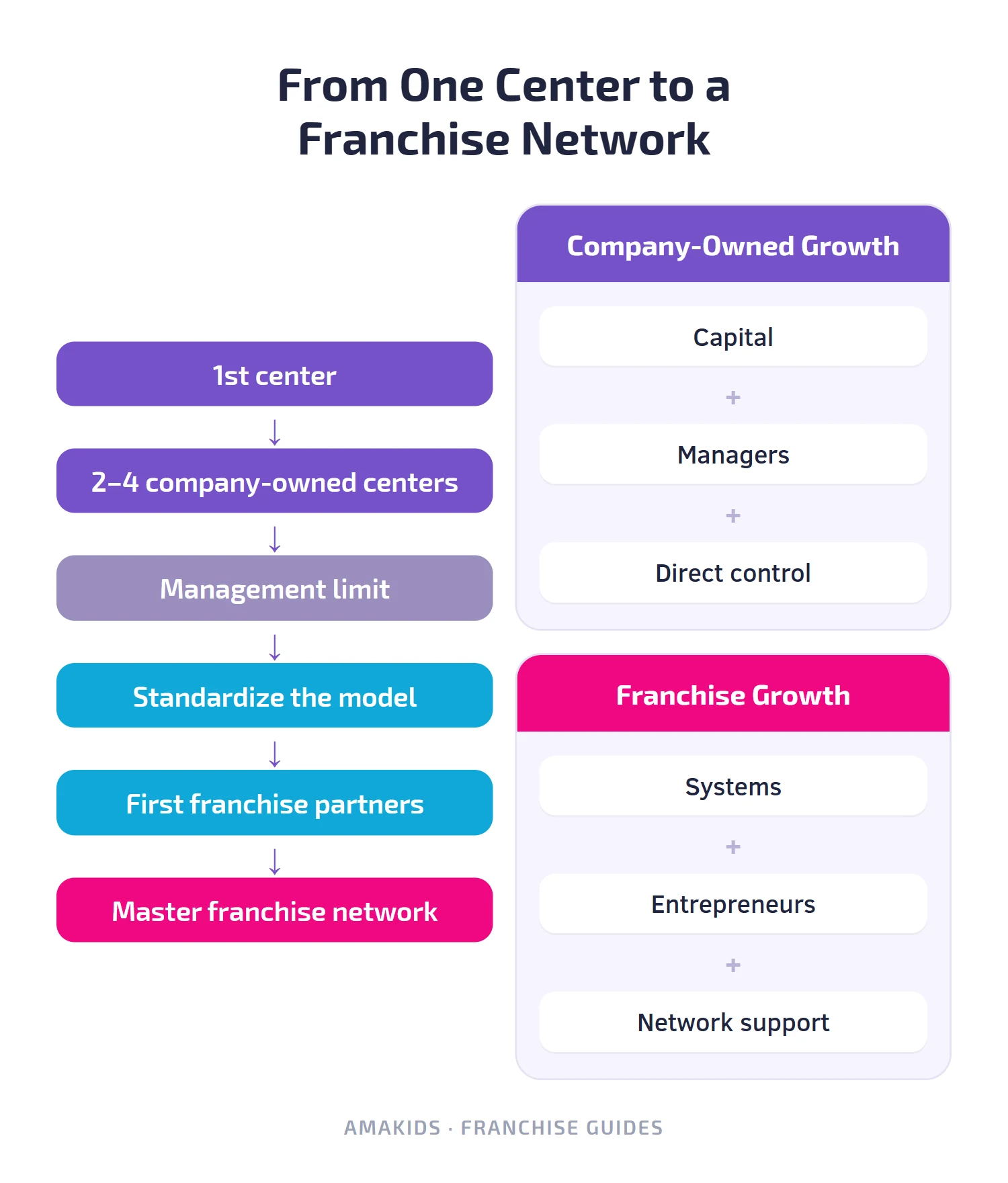
A Natural Growth Path May Look Like This
Stage 1 — First Center
The entrepreneur learns the business.
Stage 2 — Second and Third Centers
The model is tested for repeatability.
Stage 3 — Several Strong Company-Owned Centers
The entrepreneur develops operational experience and understands the local economics.
At the same time, the limits of scaling only through hired managers become clearer.
Stage 4 — Standardization
Experience is converted into procedures, tools and operating standards.
Stage 5 — First Subfranchisees
The system is tested with independent entrepreneurs.
Stage 6 — Building the Management Company
Support, training, marketing and network control are established.
Stage 7 — Territorial Development
The network can begin growing faster than would be possible through company-owned centers and hired managers alone.
How AMAkids Approaches Master Franchise Development
AMAkids Master Franchise is designed for entrepreneurs who want to develop a territory rather than operate only one education center.
The development logic should remain entrepreneurial.
First, understand the local market and prove the model.
Then learn how to repeat it.
Then transfer it to other entrepreneurs.
A practical development path may look like:
first successful center → several company-owned locations → standardization → first franchise partners → territorial expansion.
AMAkids provides the core system:
- education programs;
- methodology;
- teacher training;
- digital learning platform;
- CRM;
- operating standards;
- accumulated network experience.
But building the business across the territory becomes the responsibility of the Master Partner.
Who Is Master Franchise Best Suited For?
This model may be especially relevant for an entrepreneur who:
- already understands business operations;
- wants to build a large network;
- has strong organizational skills;
- is good at working with people;
- has capital available;
- can build a management team;
- is comfortable working with other entrepreneurs;
- thinks in terms of territories rather than a single center.
Most importantly:
they should be interested in building a system in which not only their own locations succeed, but other entrepreneurs can succeed as well.
The Key Question
A Master Franchise becomes a logical next step not simply because an entrepreneur wants rights to a larger territory.
It becomes logical when the entrepreneur can say:
“I have built a successful education business. I know how to repeat the model. But the territory is much larger than the number of centers I can manage effectively myself.”
At that point, another challenge also becomes clear.
A company-owned network requires an increasing number of strong managers.
Strong managers may eventually want to build businesses of their own.
Weak managers may fail to deliver the required results.
So the next stage is not necessarily to open twenty more company-owned branches and search for twenty perfect employees.
The next stage may be to build a system that allows twenty strong entrepreneurs to create and operate successful centers of their own.
That is the point where a successful education business begins to become a true network.
Ready to develop more than one education center? Explore the AMAkids Master Franchise model and learn how a proven local business can grow into a regional or national network.
Explore Master Franchise →Considering an AMAkids franchise? Get the partnership presentation: formats, programs and launch support.
Get the presentation