Opening a Children’s Learning Center: Independently or Through a Franchise?
You have decided to open a children’s learning center. Perhaps you have already found a promising location, know some excellent teachers, or noticed that families in your area have limited options for after-school learning.
Now comes an important decision: should you build your own brand and put together the educational offer yourself, or join an education franchise?
Both routes lead to a business of your own. The difference lies in what you start with, which responsibilities you take on, and what support you are willing to pay for.
A useful comparison begins with your circumstances. What do you already have? What is missing? And what would it take to fill those gaps?
What Opening an Independent Center Involves
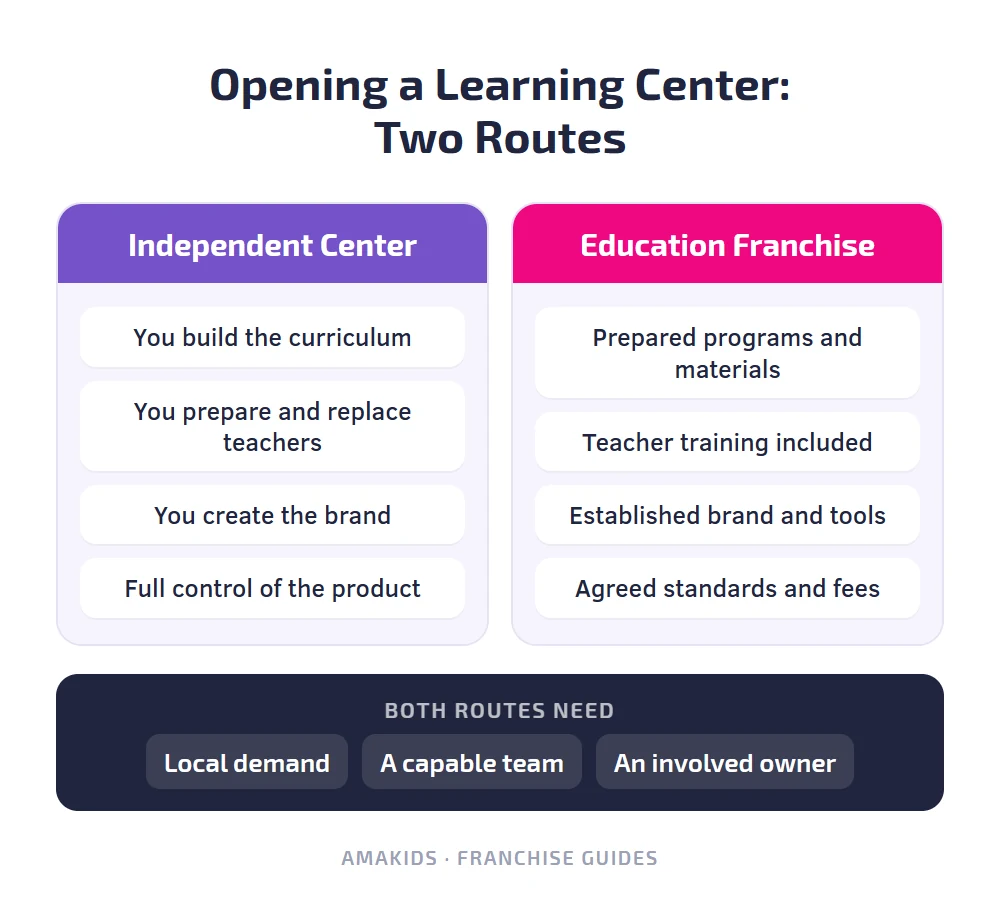
An independent learning center gives you freedom to choose your name, courses, teachers, and approach to learning. You can begin with one program, adjust the timetable after your first enrollment period, and develop your own curriculum over time.
This can suit an experienced teacher with an established course, a school owner, or an entrepreneur working with a strong educational team.
However, each choice brings work with it.
Choosing mental arithmetic as a subject, for example, is only the beginning. You still need to decide which curriculum to use, how teachers will be prepared, what materials students need, and how their progress will be monitored.
The same applies to English classes, memory development, and other educational programs. Parents want to understand what their children will learn and how the course is organized. A good course name and a collection of exercises are only part of the offer.
Before opening, you need a practical way to manage:
- Curriculum and teaching materials.
- Teacher preparation and staff replacement.
- Lessons and home practice.
- Communication with parents.
- Enrollment, payments, and scheduling.
- Marketing and student recruitment.
You can hire specialists or use external services for some of this work. The owner still needs to choose those solutions, make sure they work together, and assess whether they meet the center’s needs.
What an Education Franchise Changes
An education franchise gives you access to an existing foundation. Depending on the agreement, this may include the right to use a brand, educational programs, teaching materials, teacher training, a digital platform, and ongoing support.
The value depends on how useful that package is for the business you want to build.
Suppose you plan to offer mental arithmetic classes using an abacus. As an independent operator, you would need to source or develop the curriculum, organize materials, and arrange teacher preparation. With a franchise, some of that work may already be done.
Your task is to understand what is included, whether it suits your market, and what you must organize locally.
You will still need to attract students, manage employees, and build relationships with parents. An international brand may also need an introduction in your town, particularly if families have not encountered it before.
Before committing, establish who does what: what the franchisor provides, what you handle, and what assistance remains available once classes begin.
How to Compare the Costs Fairly
At first glance, a franchise can look more expensive. Its entry fee is visible, and the agreement may include recurring payments. An independent center has no equivalent franchise fee.
Yet preparing an educational offer still costs money and time.
Curriculum development, materials, teacher training, and software all require resources. If you do much of the work yourself, consider how that affects the time you have available for finding premises, recruiting staff, or speaking with prospective parents.
Prepare two budgets using comparable assumptions: the same area, similar premises, the same subjects, and a similar number of groups.
For each option, consider three stages.
Getting ready to open. What needs to be paid for and organized before the first lesson?
Running the center. What will you spend on premises, staff, marketing, software, and any ongoing partnership fees?
Building enrollment. How will you cover expenses while your first groups are still filling?
For a more detailed breakdown, see our guide to the costs of opening a children’s education center.
This gives you a more realistic comparison than placing a franchise fee next to the cost of creating a business name and logo. You are comparing two ways to establish and operate an education business.
When an Independent Center May Suit You
Opening under your own brand is worth considering if you already have a solid foundation: a curriculum, a capable team, management experience, and an understanding of local demand.
For example, a teacher who has spent several years building a successful course and a loyal student base may want to expand while retaining control of the educational approach.
An independent model may also appeal to someone who actively wants to develop an educational product. That means being prepared to test materials, train additional teachers, gather feedback, and revise the course as it grows.
The practical question is whether you have enough resources to develop the program while also running the center.
When a Franchise Is Worth Considering
A franchise may suit you if you want to focus on running the business while using established educational programs and tools.
You might have experience in sales or management but no curriculum development team. Or you may be a teacher who wants a broader operational foundation for opening a first center.
In either case, ask specific questions about the offer:
- Can you review teaching materials and try the platform before signing?
- How are teachers trained?
- What support is available after opening?
- What is included in the price, and what costs extra?
- Which decisions can you make independently?
- What needs adapting for your language and local market?
These questions turn a general promise of support into something you can evaluate.
Ask how support would work in everyday situations: preparing your first teacher, opening your first group, replacing a staff member, or resolving a technical problem. The answers should help you picture the working relationship after the initial launch.
You May Not Need a Separate Center
If you already operate a school or learning center, you have another option: adding a program within your existing business.
You may already have premises, teachers, and relationships with families. Your immediate priorities would then be preparing the team, fitting the course into your timetable, and introducing it to parents.
That decision deserves a separate comparison. Our guide to adding a new program to an existing education center explores it in more detail.
AMAkids offers partnership formats for opening a center, adding programs to an existing school, and developing a regional network. Depending on the market and agreement, partners can discuss mental arithmetic, English, and memory development programs.
A useful first conversation starts with your circumstances: where you plan to operate, what resources you already have, and what you want to launch.
Making Your Decision
Picture the first few months after opening. You will be enrolling students, organizing schedules, speaking with parents, and supporting your teachers.
Do you also want to develop and maintain the curriculum during that period? Is there someone on your team who can take responsibility for it? Or would access to prepared programs and tools allow you to give more attention to launching the business?
An independent brand gives you greater control over the educational product. A franchise can provide a foundation that fits your needs and saves you from having to organize every element yourself.
Whichever route you choose, the center will need local demand, a capable team, and an involved owner.
Explore AMAkids education franchise and partnership options. Share your country, experience, and plans so the team can discuss a suitable format and what you would need to get started.
Explore AMAkids Partnership Models →Considering an AMAkids franchise? Get the partnership presentation: formats, programs and launch support.
Get the presentation