Can You Run an Education Franchise While Keeping Your Job?
You want to open a children’s learning center, but you are not ready to leave your current job. Keeping a salary while the business develops feels sensible. Classes may take place after school or at weekends, which appears to leave room for both commitments.
The arrangement can be workable in some circumstances. The important question is who will run the center when you are unavailable.
A timetable that fits around your job does not automatically mean the business will. Parents make inquiries during the day, staff need decisions, and preparations happen outside teaching hours.
Before committing, map the work against your actual availability.
Separate Preparation from Day-to-Day Operation
Opening a center and running an established one involve different demands.
Before the first lesson, someone must coordinate premises, equipment, teacher preparation, enrollment, and launch arrangements. Some tasks can be scheduled for evenings. Others depend on appointments or responses during working hours.
After opening, the pattern changes. Lessons follow a timetable, but inquiries, absences, payment questions, and staff issues continue between classes.
Create two plans: one for preparation and one for regular operations. For each task, identify who will handle it and when.
This will reveal whether you need temporary help during launch, an ongoing administrator, a manager, or a smaller starting format.
Assign Responsibilities Before Hiring Around Them
A common starting point is: “I’ll hire a teacher, and they can look after the center.”
That leaves several questions unanswered.
Who responds to prospective parents while the teacher is teaching? Who discusses payments? Who arranges cover if the teacher is absent? Who follows up on a concern that requires a management decision?
Define the functions first.
| Function | What needs an assigned owner |
|---|---|
| Teaching | Delivering lessons, preparing materials, reviewing learning difficulties |
| Family communication | Inquiries, bookings, administrative questions, follow-up |
| Daily coordination | Access to the premises, timetable changes, practical issues |
| Financial administration | Recording payments, checking outstanding balances, arranging routine payments |
| Management | Staffing, budgets, unresolved concerns, and operating decisions |
One person may perform several functions in a small center. The workload and expectations still need to be realistic.
A teacher can take on agreed administrative duties, but those duties require time outside lessons. They should not depend on answering messages while working with children.
Decide Which Decisions Can Be Made Without You
Delegation becomes difficult when every small decision waits for the owner.
An administrator may be able to book an introductory visit within the published timetable. A teacher may be able to resolve an ordinary homework question. A significant complaint or an unplanned expense may require management involvement.
Agree on these boundaries before opening.
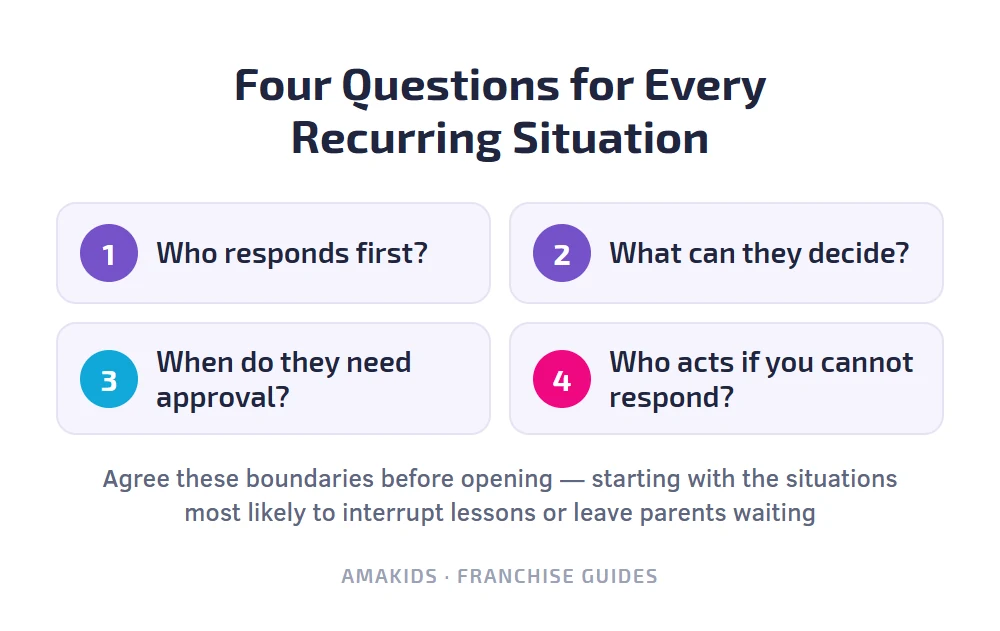
For each recurring situation, establish:
- Who responds first.
- What they can decide.
- When they need approval.
- Who acts if you cannot respond.
Consider a simple example: a teacher becomes unavailable while you are in a meeting at your main job. The center needs an agreed response, an authorized contact, and a way to notify families.
You do not need a detailed manual for every possibility. Start with the situations most likely to interrupt lessons or leave parents waiting.
For the most disruptive case, see planning for teacher absence and replacement.
Protect Time for the Owner’s Work
Reviewing the business “when there is a spare moment” is an uncertain arrangement.
Set aside regular time for the responsibilities you retain. These may include discussing enrollment with the administrator, reviewing finances, speaking with teachers, and resolving outstanding issues.
Also consider when your team can realistically reach you. An evening review helps with planning, but it will not resolve an urgent afternoon problem unless someone else has authority to act.
There is no universal number of owner hours that guarantees a workable business. Your needs depend on the format, team, enrollment, and stage of development.
Test the schedule against a difficult week as well as a normal one. What happens when your job becomes unusually demanding or a team member is away?
Include Delegation in the Budget
Keeping your job may mean paying someone to perform work you would otherwise handle yourself.
That cost belongs in the operating plan from the beginning.
A forecast that assumes the owner manages inquiries, administration, and daily coordination without payment describes one staffing arrangement. It does not necessarily describe a center whose owner is unavailable for much of the day.
For each proposed role, estimate the actual work involved. If the budget cannot support the help you need, reconsider the launch scale or timing.
Our guide to the costs of opening a children’s education center provides a broader framework for organizing the startup budget.
Keep an Organizational Connection with Families
Delegating communication should make the service reliable while preserving a clear route to management.
Parents need to know who answers routine questions and whom to contact when something remains unresolved.
Volodymyr’s experience with AMAkids and Smartum emphasizes the importance of the owner maintaining oversight and an organizational relationship with families. That does not require personally handling every message.
An administrator can coordinate everyday communication. Teachers discuss learning. The owner or designated manager remains available for issues that need a further decision.
This arrangement also reduces dependence on a single employee. If all parent contact exists only through one teacher’s private phone, a staffing change becomes much harder to manage.
Use Reporting to Identify Questions That Need Action
When you are not present throughout the day, agreed reporting becomes particularly useful.
Review information that helps you make decisions:
- New inquiries and their next steps.
- Attendance and timetable changes.
- Payments requiring attention.
- Unresolved parent questions.
- Teacher availability.
- Learning or participation concerns raised by the teaching team.
A system can make this information visible. Someone still needs to interpret it and act.
For example, a drop in home practice is a reason for the teacher to investigate. It does not automatically explain the cause. Similarly, fewer enrollments may reflect scheduling difficulties, unclear communication, or other local factors.
Keep the review focused on what needs attention and who will follow through.
Choose a Launch Format You Can Support
A dedicated center, a program within an existing school, and a regional franchise operation require different levels of coordination.
An existing school may already have reception, classrooms, and administrative staff. Those resources can help, provided responsibilities and availability are agreed.
A separate center gives you more direct control over the premises and operation, while creating additional work to organize.
If you are considering a smaller pilot, assess both its practical benefits and its dependence on the host venue. The options are explored in opening a center or testing the business model first.
Choose a format whose work you can assign and oversee.
Clarify What the Franchise Provides
A franchise may supply educational programs, teaching resources, training, technology, and guidance. Those resources can reduce the work of developing an educational offer.
They do not automatically provide local management.
Before joining, explain that you intend to keep your current job. Ask which responsibilities you will retain, whether the proposed model has relevant requirements for owner involvement, and what preparation your local team will need.
Avoid building your plan around an assumption that the franchisor will handle tasks you cannot cover.
Make the Decision Against a Real Weekly Plan
Before proceeding, you should be able to name the person responsible for lessons, inquiries, daily coordination, payments, and management decisions.
You should also know when you will review the business, how urgent issues will be handled, and whether the budget supports the arrangement.
If important work remains unassigned, resolve that gap before announcing an opening date. You may need a stronger team, a different format, or more preparation time.
Considering an education business alongside your current work? Explore AMAkids partnership options and discuss your availability, existing resources, and plans for managing the local operation.
Explore AMAkids Partnership Models →Considering an AMAkids franchise? Get the partnership presentation: formats, programs and launch support.
Get the presentation