“I Can’t See Any Progress”: How a Learning Center Should Respond
A parent stops at reception after a lesson and says, “We’ve been coming for a while, but I can’t see any progress.”
The teacher may be surprised. In class, the child completes activities that were previously difficult. The parent, meanwhile, may be looking for something else: faster calculation, more independent homework, or an improvement in schoolwork.
Before defending the course or suggesting more practice, establish what the parent means. Their concern may reveal a learning difficulty, an expectation that needs clarification, or progress the center has not explained clearly.
A useful response connects the family’s question with observations, relevant records, and an agreed next step.
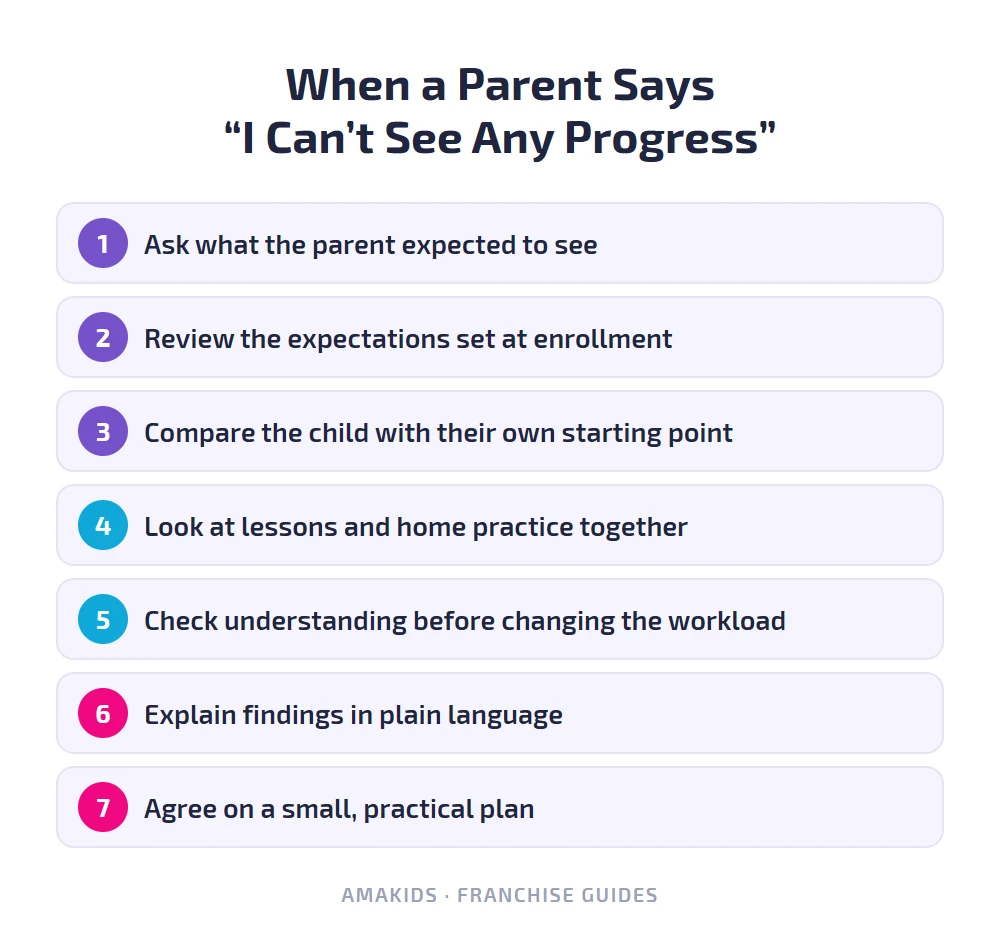
Ask What the Parent Expected to See
“No progress” can describe several different concerns.
A parent might mean that their child still needs help with an abacus exercise. They might be comparing the child with an experienced student in a video. Or they may have expected the course to improve school grades within a particular period.
Ask which change they hoped to notice and what they are currently observing.
Listen before explaining. A broad reassurance such as “Every child develops at their own pace” may be well intended, but it does not answer a specific concern.
You need enough detail to investigate:
- Which skill or activity is the parent referring to?
- What happens when the child attempts it?
- Has something recently become more difficult?
- Is the concern about lessons, home practice, or schoolwork?
These questions help define the issue without turning the conversation into an interrogation.
Review the Expectations Set at Enrollment
Check what the family was told before starting.
Were the course goals explained clearly? Did parents understand the role of regular practice? Were examples of advanced achievement presented with enough context?
If the center created an unrealistic expectation, acknowledge and correct it. Avoid replacing an earlier promise with another deadline that has no reliable basis.
For mental arithmetic, distinguish progress in taught calculation skills from broader expectations about school performance. For English, discuss the language skills covered by the course. For memory development, refer to the activities and strategies being taught rather than promising improvement in every situation.
Clear boundaries make the conversation more useful. They also help the team improve how future families are introduced to the program.
Expectations are easiest to set during the first visit: see how to organize a trial lesson.
Compare the Child with Their Own Starting Point
A general statement that a child is “doing better” is difficult for a parent to assess.
Bring together relevant examples of earlier and current work. In mental arithmetic, these may include accuracy, the difficulty of the tasks, pace, and the amount of help required.
Consider the conditions of the comparison. A child tackling more demanding work may take longer than they did on an easier activity. A change in speed alone does not explain whether understanding has improved.
Likewise, one unusually strong or difficult session should not be treated as the whole picture.
Where records are incomplete, say so. Use the information available and establish a clearer starting point for the next review rather than reconstructing results from memory.
Look at Lessons and Home Practice Together
Regular practice is part of many educational programs, but “They need to do more homework” is an incomplete response.
Review attendance, assigned work, available completion information, and the teacher’s observations.
If practice has been irregular, find out why. The family may not understand the assignment, have difficulty accessing materials, or struggle to fit the work into the child’s routine. The task itself may need explanation or adjustment within the program.
If practice has been consistent but difficulties remain, the teacher needs to investigate further. Repeating the same work without understanding the problem may not help.
Workbooks, classroom observation, and digital records can offer different information. Use them together where relevant. A platform can highlight a change in activity or errors; it cannot establish the cause on its own.
Check Understanding Before Changing the Workload
A child may repeatedly make an error because an earlier topic is not secure. Alternatively, they may understand the task but rush, lose track of instructions, or need support with a particular step.
The teacher should examine the difficulty through appropriate observation and course guidance.
Avoid responding automatically with harder tasks, more repetition, or a longer practice session. First identify what needs attention.
Any teaching adjustment should remain within the program and the teacher’s training. Where the cause is unclear, involve the appropriate academic or methodological support contact.
The purpose is to choose a useful response, not to attach a label to the child.
Explain Findings in Plain Language
Parents should leave the conversation understanding what the team has found.
Explain three things:
- What the child can currently do.
- What remains difficult.
- What the teacher proposes to address next.
Use concrete observations. For example, the child may complete a familiar activity independently but need help when a new element is introduced.
Avoid technical detail that the family does not need. An internal progress signal or a chart should be translated into an explanation of the work it refers to.
If the evidence does not yet support a clear conclusion, explain what you will review and when you will return to the family.
Agree on a Small, Practical Plan
The next step should be clear enough for both the teacher and the family to follow.
Keep it focused on the issue identified.
| Part of the plan | What to agree |
|---|---|
| Learning focus | The specific skill or difficulty being addressed |
| Teacher action | What will be explained, reviewed, or checked |
| Home practice | The appropriate assignment and any guidance needed |
| Family support | What an adult can help organize without taking over the task |
| Review | When the team and family will discuss the evidence again |
| Contact | Who will answer questions before that review |
Do not promise a particular result by the review date. The commitment is to carry out the agreed work, examine what happens, and discuss the next decision.
If the family cannot realistically follow the plan, adjust the arrangements where possible rather than leaving them with an agreement they cannot use.
Keep Responsibility Clear Within the Team
A concern can become more frustrating when parents have to repeat it to several people.
The teacher should address learning observations and appropriate teaching actions. An administrator can coordinate the conversation and handle practical arrangements. The owner or manager should become involved when the concern remains unresolved or needs a wider decision.
Record a concise summary so the relevant staff understand what was discussed. Parents should know who is following up.
Volodymyr’s experience with AMAkids and Smartum emphasizes this connection between teaching, administration, and owner oversight. Families need an accessible route to someone who can help move an unresolved issue forward.
Teachers handle these conversations better when they have practised them: preparing a teacher for their first group.
Discuss Progress Before It Becomes a Complaint
Do not wait until a parent questions the value of the course.
In his account of center practice, Volodymyr recommends reviewing progress with families roughly monthly, using earlier and current work to explain what has changed. The appropriate timing should fit the course and the student’s situation.
A brief update can cover what has been learned, what still needs practice, and what comes next.
This does not require a long report after every lesson. It requires a consistent way to make the learning journey understandable.
If a difficulty appears, communicate early. A family should not discover only at a renewal conversation that the teacher has been concerned for several weeks.
Recognize When the Issue Is Broader Than Progress
Sometimes further discussion reveals a change in family circumstances.
The timetable may have become difficult, the child may want to try another activity, or the household may need to reconsider spending.
Ask respectfully rather than assuming that every decision to stop reflects dissatisfaction with teaching.
Where appropriate, discuss available options under the center’s actual terms. A suitable response may be an adjustment, a pause, or a clear ending to the course.
The aim is to help the family make an informed decision and ensure that any learning concern has been properly addressed.
Planning a learning center or adding an educational program to your school? Explore AMAkids partnership options and discuss teacher preparation, learning resources, and progress communication for your selected programs.
Explore AMAkids Partnership Models →Considering an AMAkids franchise? Get the partnership presentation: formats, programs and launch support.
Get the presentation