Trial Lessons at a Children’s Learning Center: Helping Families Decide
A family attends a trial lesson. The child enjoys the activities, the parents smile, and everyone thanks the teacher afterward. It seems to have gone well. But when you suggest choosing a regular class, the answer is: “We’ll think about it.”
There may be several reasons. The timetable does not fit, the price needs discussing, or the child was tired after school. Sometimes parents simply leave without understanding what their child would learn next or how progress would be reviewed.
A trial lesson introduces a family to your center. To help them make an informed decision, give attention both to the learning experience and to the questions parents bring with them.
Children and Parents Have Different Questions
For a child, the first visit is about discovering an unfamiliar place. Who will teach them? Are the activities interesting? Can they manage the task? Is it OK to ask for help?
Parents are considering the program, the teacher’s approach, the organization of classes, the timetable, and the cost.
A child may enjoy the lesson while the adults remain uncertain. Alternatively, parents may hear a convincing presentation while their child has little opportunity to participate or get to know the teacher.
Plan for both experiences. Children need to try something themselves. Adults need enough information to decide whether regular lessons would suit their family.
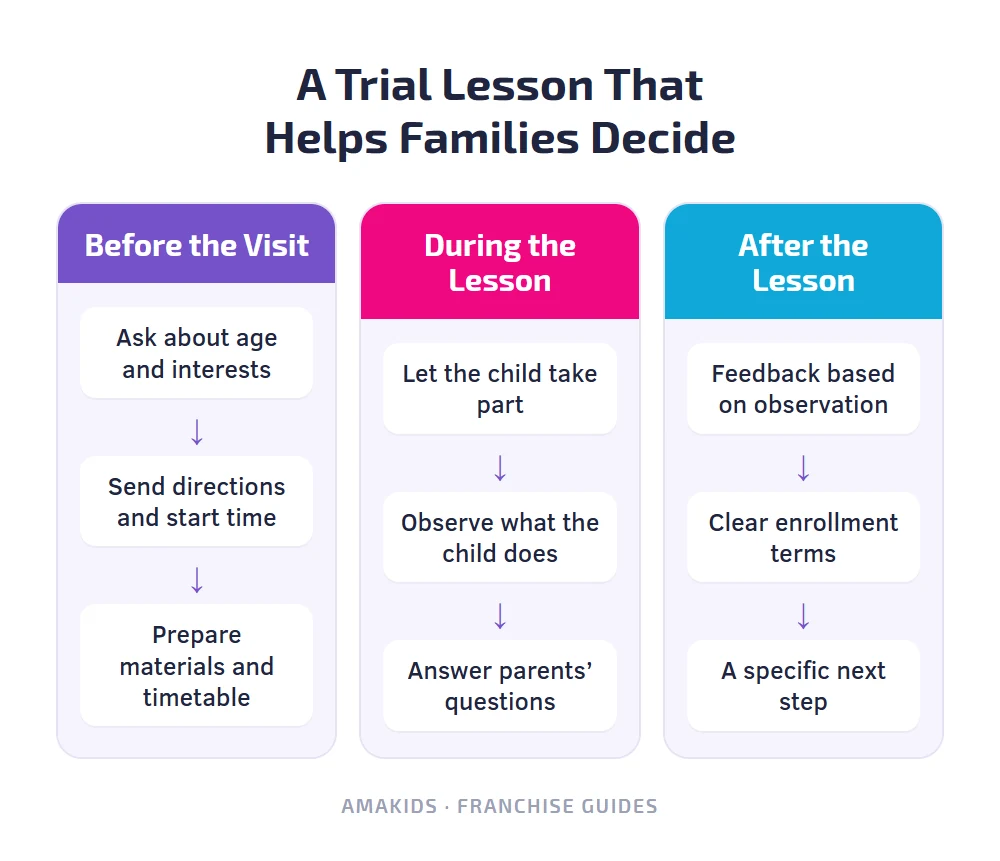
The First Impression Starts Before the Lesson
The family’s experience begins when they book. This is a useful moment to ask about the child’s age, the program they are interested in, and what prompted the inquiry.
“We want something educational” can mean different things. One family wants an engaging after-school activity. Another is curious about mental arithmetic. A third needs an English course with a suitable group and timetable.
Knowing this helps your team prepare for the conversation. It does not mean promising that the course will meet every expectation.
Before the visit, send clear directions, the start time, and any practical information the family needs. If parents arrive on time but spend several minutes searching for the entrance, their impression of the center is already taking shape.
The team needs to be ready, too: working equipment, prepared materials, an up-to-date timetable, and clear enrollment information. Families should not have to wait while staff work out which groups are available.
Give the Child a Chance to Participate
During a trial lesson, children need an opportunity to take part in activities they can approach with the teacher’s guidance.
When exploring mental arithmetic, for example, a child might encounter an abacus for the first time, attempt an introductory task, and receive feedback. The specific activities should follow the program and be delivered by a prepared teacher.
An impressive demonstration by an experienced student may spark interest, but families also need to see how the teacher works with their own child.
Notice the everyday interactions. Does the teacher recognize uncertainty? Allow time to think? Offer help after a mistake? These moments give parents a glimpse of what regular learning could look like.
Avoid treating the first meeting as a test of a child’s potential. They may be shy, adjusting to the room, or responding more slowly than usual. One lesson cannot establish what they will achieve over a full course.
How to get the teacher ready for this kind of lesson: preparing a teacher for their first group.
Explain What Happens After the First Visit
An enjoyable trial creates an impression. To decide about enrollment, parents also need to picture an ordinary month of learning.
Explain:
- What the course covers.
- How regular lessons are organized.
- Which learning materials are used.
- Whether home practice is expected.
- How the teacher discusses progress with parents.
- Whom to contact with learning or administrative questions.
For mental arithmetic, explain how teacher-led lessons, workbooks, and digital practice fit together. Families should understand the course as a whole, rather than leave thinking they are mainly buying access to an app.
If your center also offers English or memory development, there is no need to give every program equal attention during the conversation. Start with the course the family came to explore. Discuss other subjects when they are relevant to the family’s interests.
Base Feedback on What You Observed
After the lesson, parents naturally want to hear something about their child.
“Everything was great—they’re very talented” sounds encouraging, but offers little detail. A specific observation is more useful: the child listened carefully, tried a new task independently, asked questions, or needed additional support at a particular point.
Distinguish between what you observed today and what can only be assessed over time.
You might explain that a child became more comfortable participating after getting to know the teacher. That does not justify promising improvements across all school subjects within a fixed period.
Clear, measured feedback helps families understand your approach. It also establishes a useful basis for future conversations about the student’s work and progress.
Make the Enrollment Terms Easy to Understand
Even an interested family may delay if they have to piece together the offer from several messages.
Prepare a short summary they can refer to after the visit.
| The family’s question | What to explain |
|---|---|
| When are the lessons? | Days, times, lesson length, and the proposed start date |
| Who will teach my child? | The teacher and how groups are formed |
| How much does it cost? | The fee and what it includes |
| Are there additional costs? | Materials or other charges, where applicable |
| What happens if we miss a lesson? | The center’s current absence policy |
| How do we enroll? | The next step and the appropriate staff contact |
The information must reflect the actual offer at that location. If a group is still being formed, explain its status and how the start date will be confirmed.
Offer a Clear Next Step
At the end of the visit, families should know how to proceed. They might choose an available group, receive the terms in writing, or ask a remaining question.
If parents say they need time, gently explore what remains unresolved. They may need to compare schedules at home, or they may still be unsure about the program itself. Those situations call for different follow-up conversations.
If the family agrees to stay in touch, arrange a convenient way to contact them. Follow-up should help resolve a specific question.
Avoid manufactured urgency. If places are genuinely limited, explain the availability accurately. If they are not, there is no reason to suggest otherwise.
Review the Whole Enrollment Journey
As a center owner, look at several stages: booking, attendance, discussion of the offer, and the start of regular lessons.
If families book but do not attend, review timing, reminders, and directions. If they attend but do not continue, investigate the reasons: timetable, price, expectations, the child’s experience, or uncertainty about the offer.
Look beyond the first payment as well. A high enrollment rate after trial lessons tells you little about the quality of the introduction if families later discover that the course differs from what they expected.
Gather feedback and discuss it with the team. Try to identify where uncertainty arises and what the center could explain or organize more clearly.
What Families Should Take Away
A child should leave with some experience of working with the teacher and participating in a lesson. Parents should understand the course, the terms, and the next step.
For the center owner, this means coordinating the whole visit: a welcoming arrival, a prepared lesson, specific feedback, and a clear offer.
Planning to open a children’s learning center or introduce a program in an existing school? Explore AMAkids partnership options and discuss team preparation, teaching materials, and launch planning.
Explore AMAkids Partnership Models →Considering an AMAkids franchise? Get the partnership presentation: formats, programs and launch support.
Get the presentation