Not Enough Students to Start a Class? A Guide for Learning Centre Owners
The teacher is ready. The classroom is available. Several parents have expressed interest, but only a few have confirmed that their children will attend.
The planned start date is approaching. Should you open the group, postpone it or offer families another option?
For a children’s learning centre, this decision affects more than classroom occupancy. Families are arranging their schedules, a teacher is reserving time, and the centre needs to deliver what it has promised.
Before sending another advertisement or moving the date, establish exactly what is preventing the group from starting.
Count confirmed places separately from expressions of interest
A list of enquiries can make a group look almost full.
Yet those families may be at very different stages. Some have asked about fees. Others have attended a trial lesson but cannot attend the proposed time. A few may be ready to enrol once a start date is confirmed.
Record those differences.
For the proposed class, identify which families have accepted the available schedule and completed your centre’s confirmation process. Keep them separate from parents who are still deciding or waiting for another time.
This gives you two useful numbers: the places you can currently rely on and the families with whom a specific question remains unresolved.
Follow up on those questions individually. A parent waiting for timetable information needs a clear answer about timing. Sending another description of the programme does little to move that decision forward.
Find out whether the timetable is dividing demand
Sometimes there is interest in a course, but it is spread across too many possible times.
Imagine that several families want mental arithmetic lessons. Some prefer Tuesday, others Thursday, and a few can attend only at weekends. The centre has enough enquiries to look promising, but no workable group.
Ask which times are genuinely possible for each family. Distinguish a preference from a firm restriction.
Then look for an option with enough overlap. Before proposing it, check teacher availability, room access and whether the children belong in the same learning group.
Avoid offering more time slots than the centre can reasonably establish. Each additional option can leave another small set of families waiting for classmates.
Decide what makes a small-group launch workable
There is no universal minimum number of children that makes every class viable.
The answer depends on the programme, teaching format, fees and operating costs. A class in an existing centre may have different costs from one requiring a separate room booking and additional teacher hours.
Check the cost of delivering the group at its current size. Include preparation and administration, relevant materials and platform charges, and any additional venue costs.
Also consider the wider business. A group may cover its immediate delivery costs while contributing too little towards the centre’s ongoing expenses.
Starting below your intended group size can be a deliberate launch decision. If you choose that approach, define how much support the business can provide and when you will review the arrangement.
Do not build the decision around an assumption that more children will certainly join next month.
For the wider budget, see planning the centre’s operating costs.
Check the educational fit before combining groups
Combining two small groups can look like an obvious solution. The children may be studying the same programme and have compatible schedules.
The teacher still needs to assess whether they can learn effectively together.
Age, prior learning and current understanding may affect that decision. In English, for example, children of similar ages may have substantially different language experience. In mental arithmetic, one group may already be using skills that newcomers have not encountered.
Ask the teacher to review the proposed combination before discussing it as a confirmed option with families.
The same care applies to adding beginners to an existing class. A spare seat does not establish that the class is suitable for them.
Give waiting families a decision date
“We’re still forming the group” provides a status update without helping a parent plan.
Explain what is confirmed, what remains uncertain and when the centre will make its decision. Choose a date that gives families reasonable time to respond before the intended start.
A message might say:
“The Wednesday class is still being formed. We will confirm by Friday whether it can begin on the proposed date. If it cannot, we will contact you with the available alternatives.”
Use wording that reflects the actual situation and the arrangements agreed with families. If payments have already been collected, explain how they will be handled under the applicable terms.
Repeated postponements leave parents unable to organise another activity. Once the decision date arrives, give them a clear answer, even if the answer is that this particular group will not launch.
Address the obstacle before offering a discount
A reduced fee is useful only if price is the issue preventing enrolment.
It will not resolve an unsuitable timetable, a difficult journey or uncertainty about what the child will learn.
Ask parents who are still considering the class what remains unresolved. Their answers may reveal something you can address directly: unclear information, an unanswered question after a trial lesson or a schedule that was never firmly confirmed.
If you decide to offer introductory terms, calculate their effect on the group’s costs. Explain the duration and subsequent fee clearly.
A launch offer should support a workable class. Otherwise, the centre can end up teaching a small group at a lower fee while facing the same original difficulty.
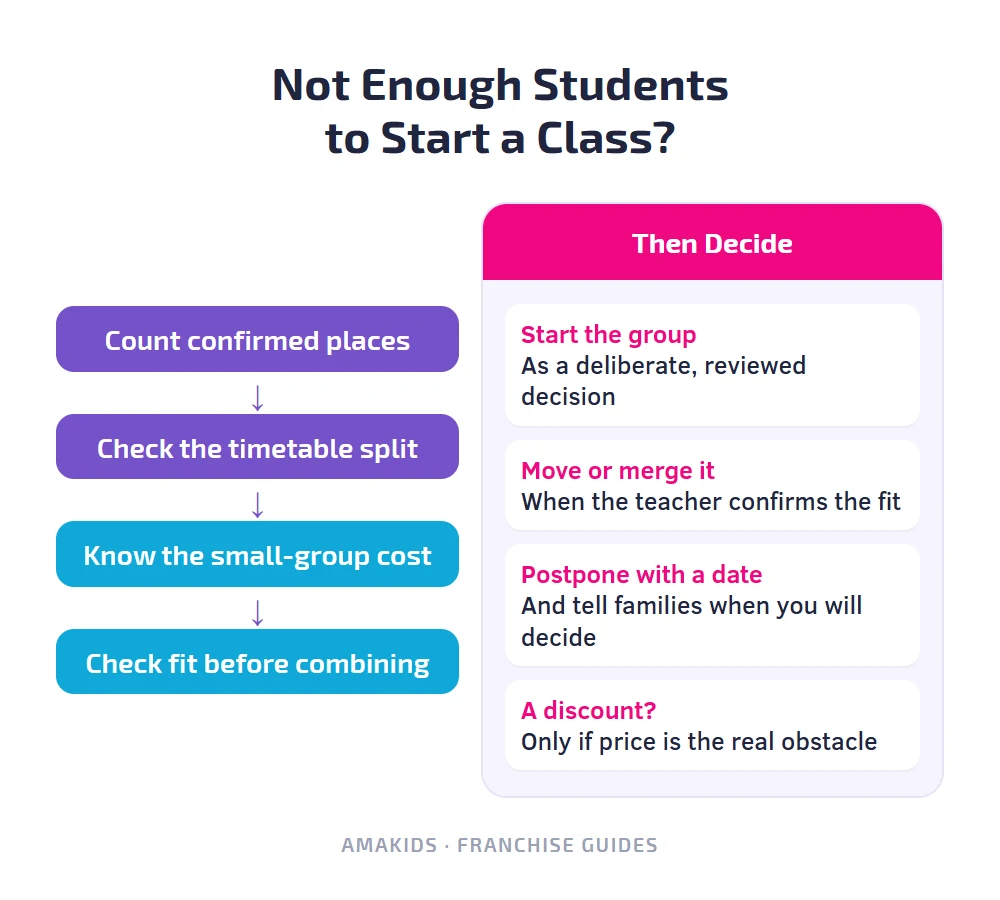
Choose a clear outcome and review what happened
By the decision date, choose an arrangement the centre can deliver.
That may mean opening a smaller group with a defined review plan, agreeing on a suitable alternative with families, or closing this intake and organising a later one.
Confirm the outcome with the teacher and administrator before contacting parents, so everyone gives the same information.
Afterwards, review where the proposed group lost momentum. Were there too few relevant enquiries? Did interested families need a different time? Were confirmations delayed because the offer remained unclear?
Those findings should shape the next intake.
A group that does not launch provides information about a particular offer, schedule and recruitment period. Use that information carefully before drawing conclusions about the whole programme or local market.
If you are considering an AMAkids partnership, contact the franchise team to discuss launch planning and the support available for your intended format and market.
Contact the AMAkids Franchise Team →Considering an AMAkids franchise? Get the partnership presentation: formats, programs and launch support.
Get the presentation