How to Choose Premises for a Children’s Learning Center: What to Check Before Renting
The photos look promising: bright rooms, a recent renovation, and a reasonable rent. During the viewing, you can already picture the classroom layout, your sign above the entrance, and the first families arriving.
Before agreeing to rent, imagine an ordinary working afternoon. Parents bring children after school. One class finishes while the next group gathers near the entrance. A teacher needs to prepare the room, and an administrator is speaking with a family visiting for the first time.
That is when you begin to see whether the space will work.
Start by assessing the location and everyday use of the premises. Then check the technical details, restrictions, and rental terms.
Start with the Families Who Will Attend
Before viewing properties, decide who your center will serve. Consider the children’s ages, your likely timetable, and how families usually travel.
Younger children will often depend on an adult to bring them. Think about the whole journey: collecting a child from school, getting to the lesson, and returning home afterward.
Being close to a school can be an advantage. However, a short distance on a map may hide a busy road, an awkward crossing, or a lengthy drive around a one-way system.
Walk the route yourself. If you expect most families to drive, try the journey at the time your classes would take place.
Speak with prospective parents in the neighborhood, too. Ask where their children go to school, when the school day ends, and which days could work for additional classes. Even a few conversations can help you test your assumptions about the location.
Check the Journey from the Street to the Classroom
It is easy to focus on the rooms and overlook everything families must navigate before reaching them.
Imagine a parent arriving for the first time. They need to find the building, identify the entrance, and reach your center without confusion.
During the viewing, check:
- Whether the entrance is visible from the usual direction of arrival.
- How easily you could explain the route to a new family.
- Whether the approach is convenient for an adult accompanying a child.
- How well the entrance and surrounding area are lit in the evening.
- The practicality of stairs, doors, and lifts, where applicable.
- Where families can pause while entering or leaving.
If parents will drive, assess drop-off arrangements and parking during your proposed teaching hours. Empty spaces in the morning tell you little about availability after school.
An inconvenient approach does not automatically rule out a property. It does need to be considered before you invest in fitting out and promoting the center.
Test the Layout Against Your Timetable
Floor area alone does not tell you how well a center will operate. Two properties of the same size can offer very different working conditions.
Sketch a simple plan showing classrooms, the entrance, reception, waiting space, and storage. Then use your proposed timetable to picture several consecutive classes moving through the building.
Where will children leave their belongings? What happens when arriving families meet those leaving? Can the teacher prepare for the next lesson? Where could an administrator speak with a parent without disturbing a class?
Pay particular attention to the changeover between groups. A space that feels comfortable during one lesson may become crowded when the next group arrives early.
Plan storage as well. Workbooks, abacuses, stationery, and other resources need a place of their own. Without it, materials gradually take over teaching surfaces and circulation areas.
Match the Space to Your Programs
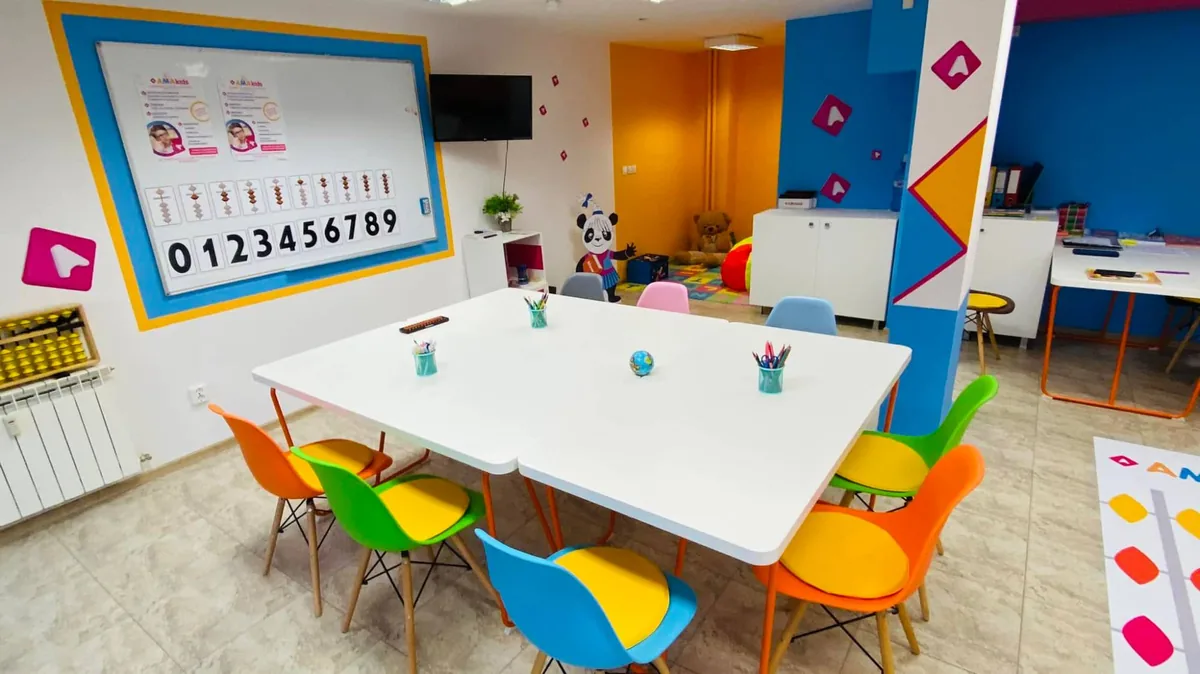
Your classroom needs will depend on the programs you intend to offer.
For mental arithmetic classes using an abacus, consider desk arrangements, clear sightlines to the teacher’s demonstration, and equipment storage. English lessons may benefit from flexible seating and space for pair work. If lessons use a screen or digital resources, check visibility from different seats.
You do not need to equip the center for every possible future course immediately. It is useful, however, to understand what changes an additional program would require.
If you are opening through a franchise, request the relevant classroom requirements and recommendations before committing to a property. Compare them with the floor plan while you still have the option to consider another location.
Visit During Your Future Teaching Hours
A quiet property at midday can feel very different in the evening.
Arrange another viewing during the hours you expect to teach. Listen to neighboring businesses and street activity. Notice music, visitor traffic, equipment noise, and how clearly sound travels between rooms.
Assess the lighting, temperature, odors, and ventilation. Ask about heating, air conditioning, and ventilation systems, and bring in a technical specialist where necessary.
If your courses use digital learning tools, check internet connection options, power socket locations, and where equipment could be installed.
Record questions as you go. After several viewings, it becomes surprisingly easy to confuse the details of similar properties.
Confirm What You Will Actually Be Allowed to Do
During a viewing, a landlord might say, “Your sign can go here,” “That partition can be removed,” or “You can use the building at weekends.”
Each point can affect how your center operates. Before signing, confirm what is permitted and how those arrangements will be documented.
Discuss:
- Access hours, including weekends and public holidays.
- Signs and directions to your entrance.
- Alterations, fit-out work, and changes to the layout.
- Use of shared areas.
- Equipment maintenance.
- Additional charges.
- Responsibility for repairs and faults.
Separately, confirm whether the premises can be used for your proposed activities and which local approvals are needed. This depends on the country, building, and type of operation.
A franchisor’s guidance can help you plan the center. Applicable local requirements still need to be checked for the property you are considering.
Compare Properties Using the Same Checklist
After several viewings, it is tempting to choose the place you simply liked most. Put each option into the same comparison table so that practical considerations remain visible.
| Criterion | What to record |
|---|---|
| Family journeys | Actual routes, travel times, and main inconveniences |
| Entrance and access | Ease of finding the entrance, stairs, lifts, and building access hours |
| Layout | Classrooms, group changeovers, waiting space, and storage |
| Teaching conditions | Noise, lighting, temperature, and ventilation |
| Technical readiness | Internet, electrical provision, and equipment needs |
| Preparation | Work required before opening and the likely time involved |
| Property costs | Rent, compulsory charges, fit-out, and maintenance |
| Unanswered questions | What still needs confirmation and who can provide it |
Identify essential conditions first. If the building closes before your final class ends, a beautiful interior will not solve the problem. A shortage of furniture may be much easier to address.
Keep the wider startup budget separate. Staffing, marketing, and other costs are covered in our guide to how much it costs to open a children’s education center.
Make the Decision After the Checks
Before choosing, return to one practical question: can your team run the planned timetable here, and can families attend regularly and conveniently?
If doubts remain, visit again with a prospective teacher or administrator. They may spot something you missed, such as poor screen visibility, inadequate storage, or congestion when groups arrive.
The premises should fit your launch format, resources, and operating plan. List the checks you need, resolve questions about restrictions, and then make your rental decision.
Planning to open an AMAkids center? Explore our partnership options and discuss your chosen programs and classroom needs before making your final property decision.
Discuss Opening an AMAkids Center →Considering an AMAkids franchise? Get the partnership presentation: formats, programs and launch support.
Get the presentation