How to Attract Your First Students to a Children’s Learning Center
The classroom is ready, the teacher has completed training, and the timetable is planned. Now you need students—and this is where opening a new center can become challenging.
Local parents do not yet know your teachers or your center. You have no local reviews and few families who can recommend the classes. Your marketing needs to introduce the offer and give parents a reason to consider it for their child.
Attracting your first students involves several connected tasks: explaining the program clearly, speaking with local families, making enrollment straightforward, and following up on inquiries.
Start with a Specific Program and Audience
“We develop children’s abilities” is a broad introduction. It leaves parents wondering what you actually offer, whether it suits their child, and why they should contact you.
Begin with a program, an age group, and realistic lesson times.
For mental arithmetic, explain that children will learn abacus-based calculation with a teacher. For English classes, identify the intended age or language level. For memory development, describe the kinds of learning activities the program covers.
You do not need to fit every course into one advertisement. Make it easy for a family to recognize a relevant offer and take the next step.
Check that your message answers these questions:
- What ages are the classes for?
- What program is being offered?
- Where is the center?
- When will lessons take place?
- How can parents ask questions or arrange an introductory visit?
Some details may depend on forming the first groups. If so, explain what is confirmed and what is still being arranged.
Understand How Local Families Choose Activities
A network’s international experience can be helpful. Your first students, however, will come from particular neighborhoods and schools.
Explore the activities children already attend locally. How do parents discover them? Do families usually drive, or look for classes within walking distance? How far ahead do they organize their schedules?
Sports clubs, language schools, and creative workshops suggest that families are familiar with supplementary education. Their presence alone does not establish demand for your particular course.
Speak with parents to test your assumptions. Ask which activities they are considering, what times would work, and what makes attendance difficult.
Sometimes the obstacle is the journey or the start time. Discovering this early gives you an opportunity to adjust the offer before spending money promoting it.
Use Conversations to Understand What Parents Need
Volodymyr, the founder behind the AMAkids and Smartum education projects, recalls speaking directly with parents near schools during an early launch. He asked about their children’s learning, difficulties, and workload before introducing the program.
The useful lesson is the order of that conversation: understand the family’s situation first, then explain what you offer.
You do not need to reproduce the same approach in every location. Opportunities for meeting parents depend on local rules and habits. You might speak at a family event, hold an open session, arrange a presentation with a school, or talk with someone who has already contacted the center.
The questions remain useful. What interested the family? Which activities does the child already attend? What matters when choosing a teacher? What are the parents hoping to find?
Their answers help you communicate more clearly. Avoid using a child’s difficulties to pressure a family or suggesting that one program can solve every school-related problem.
Give Families Somewhere to Check the Details
After seeing an advertisement or speaking with you, a parent may want to explore the center independently.
Prepare a website page or clear local profile with current contact information, the address, photographs, and a description of the program. If you use map listings and social media, make sure the basic details are consistent.
Real photographs of the premises and team help families picture where their child would learn.
Video can show a teacher working with children and give a sense of the classroom experience. If it features a student calculating quickly, present that as the individual student’s achievement. It should not imply that every beginner will reach the same result. Obtain the necessary permissions before publishing material featuring children.
A new center does not need to appear as though it has been operating for years. Parents need accurate information and a reliable way to reach someone who can answer their questions.
Choose Channels That Reach Local Families
At launch, combine a few ways of reaching the audience you want to serve.
These might include local advertising, open events, cooperation with schools or family organizations, social media, or printed materials distributed in relevant locations.
Choose according to the neighborhood. A school partnership, for example, may allow you to introduce the program to families already using educational services. Leaflets need a clear offer and thoughtful distribution; the number printed tells you little about future enrollment.
Arrangements with local organizations should be transparent. Families should understand who is running an event, which organization is presenting the program, and how to contact the center.
Follow the rules of local online communities, too. Identify yourself as the owner or a member of the team. A parent’s genuine recommendation is valuable because it reflects their own experience.
Give Your First Families Particular Attention
In his account of early enrollment, Volodymyr emphasizes the importance of the first five to seven families. This is a personal observation from his experience: those first students help the center get started, and their impressions can lead to further recommendations.
It is not a threshold after which enrollment grows automatically.
Families first need to receive the experience they were promised: a prepared teacher, well-organized lessons, and someone available to discuss questions.
Ask early parents whether booking was straightforward, the terms were clear, and the location was convenient. Find out what remained uncertain after their first visit. Their feedback can help you improve the experience before expanding recruitment.
Invite recommendations after families have had a genuine opportunity to get to know the center. If lessons are offered on special terms in exchange for promotional posts, make that relationship clear.
Organize Inquiry Handling Before Advertising
Advertising may bring an interested parent to you. What happens next matters.
Assign responsibility for responding to inquiries. Prepare current information about the program, ages, timetable, and fees. Agree on how inquiries will be recorded so they do not disappear between a teacher’s private messages and the administrator’s phone.
A simple record is enough to begin.
| What to record | Why it helps |
|---|---|
| Inquiry source | Shows where interested families are finding you |
| Child’s age and program of interest | Helps you suggest a suitable option |
| Preferred lesson times | Reveals opportunities to form groups |
| Agreed next step | Keeps the conversation moving |
| Outcome | Distinguishes interest, a booked visit, and enrollment |
If parents need to discuss the decision at home, agree on a specific follow-up rather than sending the same reminder to everyone.
The trial lesson itself needs separate preparation. Meeting the teacher should help the family understand the course and decide whether it suits them. See our guide to organizing a trial lesson.
Track the Journey to Regular Attendance
The number of messages received is only one measure.
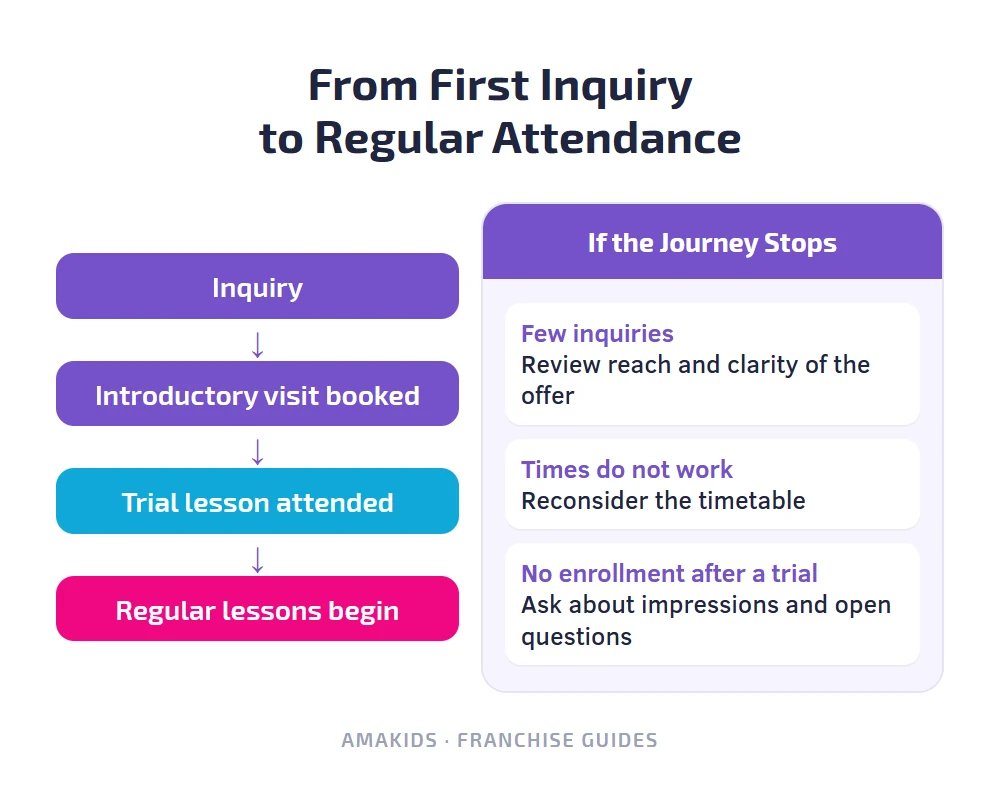
Track how many families inquire, book an introductory visit, attend, and begin regular lessons. Where parents are willing to explain, record why they decided against enrolling.
If inquiries are scarce, review your reach and the clarity of the offer. If there is interest but the times do not work, reconsider the timetable. If families attend a trial lesson but do not continue, explore their impressions and unanswered questions.
Avoid judging a channel from one family’s response. Equally, do not keep spending without understanding what is happening. Even a modest, consistently maintained record can support better decisions.
What a Franchise Contributes to the First Enrollment Campaign
Prepared programs, materials, and teacher training give you a concrete educational offer to discuss with parents. They make it easier to explain what children will study and how lessons are organized.
Local recruitment still requires the partner’s involvement. Even a brand known in other countries needs an introduction in your neighborhood, a suitable timetable, and reliable communication.
A clear offer gives families a reason to visit. Their experience of learning gives them a reason to stay and recommend the center. Keep enrollment activity connected to what happens after a child joins.
Planning to open a children’s learning center or introduce a program in an existing school? Explore AMAkids partnership options and discuss programs, team preparation, and launch planning for your market.
Explore AMAkids Partnership Models →Considering an AMAkids franchise? Get the partnership presentation: formats, programs and launch support.
Get the presentation