Does My Child Have to Compete in Mental Arithmetic?
Your child enjoys working with the abacus. They like the teacher, take part in lessons, and are pleased when a difficult calculation finally makes sense.
Then a competition is announced, and their enthusiasm disappears.
Does this mean the course is no longer right for them? Or should they be encouraged to enter anyway?
Learning mental arithmetic and taking part in a competition are related activities, but they are different commitments. A child can be interested in calculation without wanting a public result or a place in a ranking.
If your child is reluctant, begin by finding out what they are responding to. Their answer will help you and the teacher discuss a suitable next step.
Find Out What “I Don’t Want To” Means
A child might enjoy a short challenge with a friend but dislike the idea of a large event. They may worry about unfamiliar rules, being watched, or disappointing someone. They may simply prefer another kind of activity.
Ask about the particular event rather than deciding that your child “isn’t competitive.”
What do they think will happen? Which part sounds unappealing? Is there anything they would like to know before deciding?
Sometimes an explanation resolves the uncertainty. Sometimes the child understands the event perfectly well and still does not want to enter.
The teacher can contribute observations from lessons. Together, you can distinguish a question about the event from a wider difficulty with the course.
Keep Learning Progress Separate from Rankings
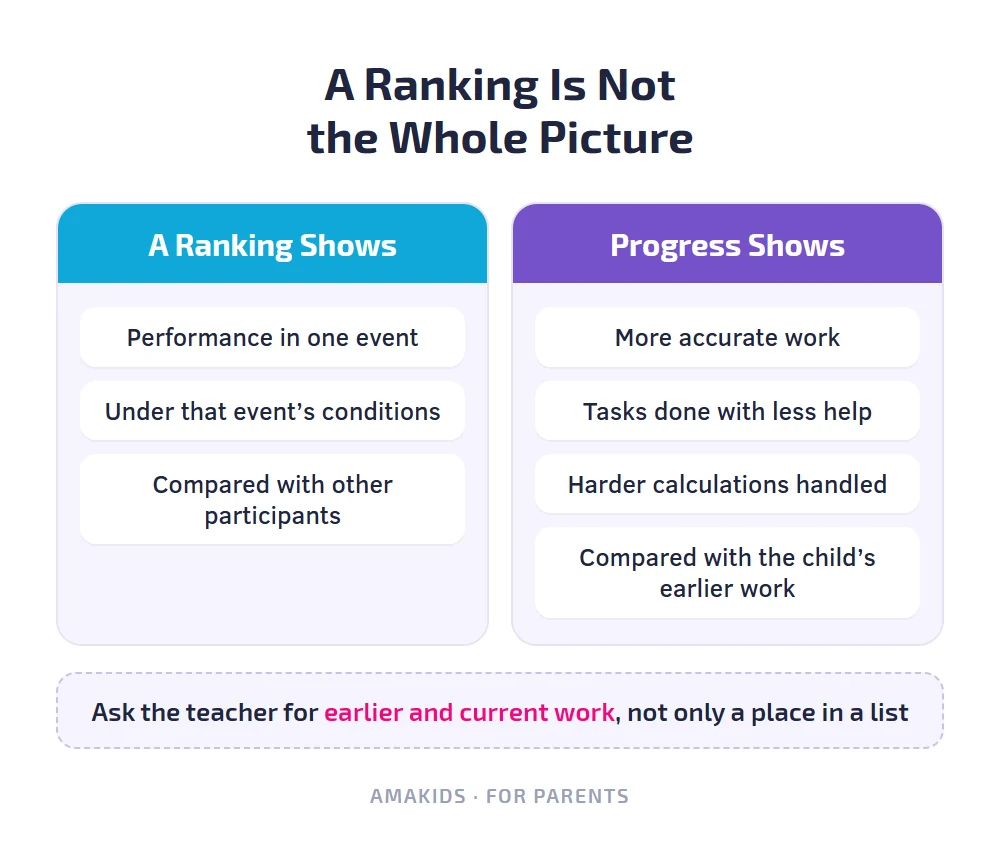
A ranking describes performance within a particular activity, under its conditions, alongside the other participants.
It does not describe everything a child has learned.
A student may have become more accurate, started completing a task independently, or learned to handle more demanding calculations. Those changes matter even if another participant scores higher.
Ask the teacher to explain progress through examples of the child’s earlier and current work. Consider task difficulty and accuracy alongside pace.
This is also useful for children who enjoy competition. Winning one event does not mean there is nothing left to learn, just as a disappointing placing does not erase previous achievement.
In the approach described by Volodymyr, the founder behind AMAkids and Smartum, comparing a child with their own earlier performance is an important reference point. Competition can sit alongside that view of learning.
Personal Goals Can Give Practice a Purpose
A child does not need an opponent for every challenge.
A teacher can help identify an appropriate personal goal: completing a familiar activity with less help, improving accuracy, or becoming more comfortable with work introduced in class.
The goal needs to fit the program and the student’s current understanding. It should give the child something recognizable to work toward without making every attempt feel like an assessment.
An observation such as “You managed that part on your own today” tells the child what changed. It is more specific than a general instruction to work harder.
Games, quests, and individual achievements may also provide reasons to return to practice. In AMAkids, the learning experience includes options beyond competitive activities; the teacher can explain what is available for the selected course.
These tools still need a learning purpose. Collecting a reward is not, by itself, evidence that a topic has been understood.
If Your Child Is Curious, Explain the Commitment
A hesitant child may decide they would like to try once the event becomes clearer.
Before committing, ask the organizer or teacher about the format, suitability, preparation, practical arrangements, and any costs. Establish what is expected from both the child and the family.
Discuss an aim that does not depend entirely on placing above other participants. For a first event, that might be understanding the format, following the instructions, or reviewing their own work afterward.
Avoid promising that it will be easy or that they will certainly win. An accurate explanation gives the child a better basis for deciding.
If they choose to participate, keep the agreed purpose visible during preparation. It is easy for a modest first goal to become pressure for a medal as the date approaches.
Talk About the Experience Afterward
After a competition, children may want to celebrate, talk through a disappointment, or take a break before discussing it.
When they are ready, ask what the experience was like. Which parts did they enjoy? Was anything unexpected? Would they want to take part again?
The teacher can review relevant work and suggest what to practice next. A competition result may provide useful information, but it needs context.
If the child chooses not to enter, continue recognizing their work in ordinary lessons. They should not feel that their effort matters less because it will not appear on a stage or in an event photograph.
Public demonstrations are one way of sharing achievement. Everyday learning contains quieter milestones, too.
Ask the Center How the Options Work
Before enrolling—or when an event is proposed—ask how the center handles competitive activities.
Useful questions include:
- Which activities are optional?
- What alternatives are available?
- How is progress reviewed outside competitions?
- How does the teacher respond when a child finds comparison uncomfortable?
- What preparation would a particular event involve?
A clear answer should help you understand the actual course arrangements. There is no need to infer them from photographs of trophies or advanced students.
You can also ask how ordinary lessons combine teacher guidance, classroom materials, and home practice. Those are important parts of the learning experience regardless of event participation.
Let Interest Guide the Next Conversation
A child’s preference can change. Someone who declines an event now may become curious later. Another student may try competition and decide they prefer individual challenges.
Keep the conversation open without making participation a test of confidence or commitment.
The question is whether the child is learning, receiving appropriate support, and finding worthwhile goals within the course. Competitions can contribute to that experience for some students. They do not need to define it for everyone.
Interested in abacus-based learning? Explore the AMAkids mental arithmetic course and ask your local center about teaching, personal learning goals, and the activities available to your child.
Explore the AMAkids Mental Arithmetic Course →Leave a request for a free consultation
Get a consultation