How to Review Teaching Materials Before Choosing an Education Franchise
A workbook can look impressive in a franchise presentation. The pages are colourful, the exercises seem engaging, and the digital activities add a sense of variety. But if you are considering opening a children’s learning centre, you need to understand how those resources will work in an actual classroom.
What will help a new teacher prepare? How do the materials connect from one lesson to the next? And what happens when a child needs something explained again?
You do not need access to an entire confidential curriculum to explore these questions. A representative sample, explained by someone who understands the programme, can make the discussion much more useful.
Ask to see how the resources fit together
Franchise presentations often show resources separately: a workbook, a teacher’s guide, a few slides and a learning platform. Each may look useful on its own. The more revealing question is how a teacher uses them together.
Ask the provider to walk you through one representative topic. What is the learning objective? Which resources help the teacher introduce it? What do children practise during the lesson, and how does any home practice relate to that work?
For example, imagine that you are shown a page from a mental arithmetic workbook. A useful explanation would connect that page to the skill being taught, the guidance available to the teacher and the practice children complete afterwards. You should come away understanding why the page exists.
This is a reasonable request before making a business commitment. The provider can choose a demonstration topic that illustrates the approach without sharing its full methodology.
Look for guidance that helps a teacher teach
Student materials are usually the easiest part of a programme to demonstrate. Teacher resources deserve equally close attention, particularly if you plan to recruit someone who has never taught the subject before.
An answer key tells a teacher whether an answer is correct. A teaching guide should help them understand what to explain, what to observe and where children may need support.
Ask to see a sample of that guidance. Does it explain the purpose of an activity? Does it address common misunderstandings? Can the teacher find the relevant information while preparing a lesson?
Consider a child who repeatedly makes the same calculation error. More exercises might provide useful practice, but the teacher first needs to understand the difficulty. Ask how training and teaching resources help them investigate it.
You are looking for a clear connection between the materials, teacher preparation and access to methodological support.
What this preparation looks like in practice: preparing a mental arithmetic teacher.
Understand how the programme develops
A sample lesson can be engaging without showing whether the wider course has a coherent structure.
Request a concise course outline alongside the demonstration materials. You should be able to understand, at a general level, how early skills support later learning and how previously introduced skills are revisited.
You do not need proprietary teaching sequences or internal assessment thresholds. You do need an explanation that goes beyond “the exercises become harder.”
Ask how teachers recognise when children need further explanation or practice. Also ask what support is available when children within the same group progress at different rates.
These questions help you assess whether the programme gives teachers a useful framework for making everyday decisions.
Check suitability for your intended students
A programme may be available internationally while still requiring preparation for your particular market.
Look closely at the language children will encounter in printed materials, instructions and digital activities. Ask which versions are currently available and who is responsible for any further adaptation.
Age suitability also deserves more than a label on the cover. Consider how much independent reading an activity requires, whether the instructions are understandable and whether the presentation suits the children you intend to enrol.
The same applies to resources for parents. If families are expected to support practice at home, they need to understand what their role involves.
Clarify these points before building your launch schedule. Translation, printing and preparation can become practical bottlenecks when responsibilities remain vague.
Try preparing a lesson with the sample package
One useful step is to involve the person who may eventually teach the programme.
After a demonstration, ask them to review the approved sample resources and describe what they would need to prepare. They should be able to identify the lesson objective, locate the relevant guidance and understand which questions require further training.
This exercise does not replace teacher certification or onboarding. It helps reveal how the package is organised.
Perhaps everything is easy to locate. Perhaps several resources are available, but their relationship needs explaining. Either finding gives you something specific to discuss with the provider.
If you have no teaching background yourself, this can be especially valuable. You can assess how clearly the system supports preparation while leaving the detailed methodological evaluation to a qualified educator.
Clarify what is included and how updates work
Once you understand the educational structure, check the practical arrangements.
Which materials are included in your agreement? Which are purchased separately or supplied for each student? Can resources be printed locally, or must they be ordered? Who can access the teacher materials?
Then ask what happens when a resource changes.
A centre needs to know which version teachers should use and how changes will be communicated. If a workbook activity is revised, for example, the related teacher guidance and home practice may also need attention.
Ask who handles questions about inconsistencies and how teachers receive clarification. Clear ownership matters here: someone at your centre needs to know where to take a methodological question and how to obtain an answer.
Make sure the arrangements discussed during the presentation are reflected in the documents governing your partnership.
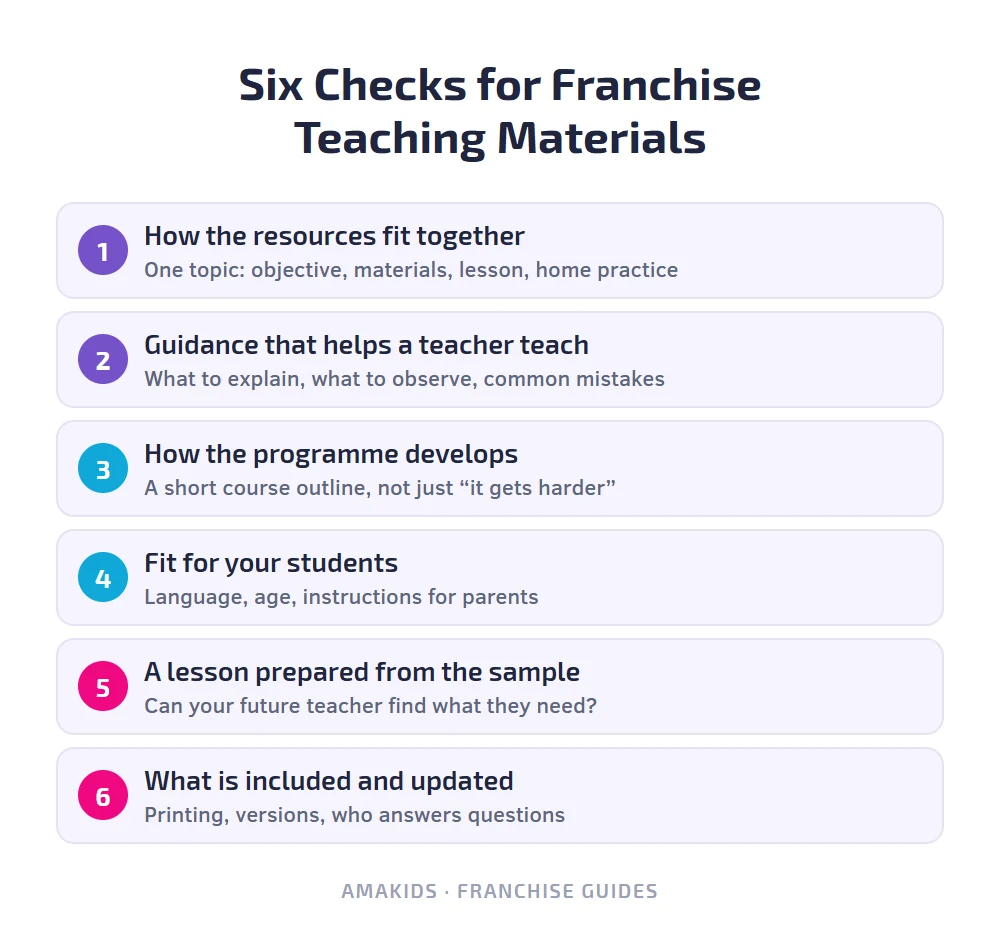
Leave with a clear picture of everyday teaching
By the end of the review, you should be able to describe how the materials support a teacher before, during and after a lesson.
You should also know what remains to be confirmed: perhaps a language version, printing arrangements, access rights or the scope of teacher training. Write those questions down while the demonstration is still fresh.
That gives you a stronger basis for comparing franchise offers. You can consider the resources in relation to the people you will recruit, the children you will teach and the work required to run the centre.
If you are exploring an AMAkids partnership, contact the franchise team to discuss the programmes and ask which demonstration materials, course outlines and teacher preparation options are available for your intended market.
Ask About AMAkids Teaching Materials →Considering an AMAkids franchise? Get the partnership presentation: formats, programs and launch support.
Get the presentation