How to Hire a Teacher for a Children’s Learning Centre
Two candidates apply for the same teaching position. One has an impressive CV and speaks confidently about working with children. The other gives quieter, more specific answers about how they prepare, notice difficulties and respond when an explanation does not work.
Which person should you hire?
An interview alone may not give you enough evidence. For a children’s learning centre, the decision needs to cover several things: how the candidate works with children, whether they can learn the programme, and whether the practical arrangements suit both sides.
A structured selection process helps you investigate those questions before building a timetable around someone.
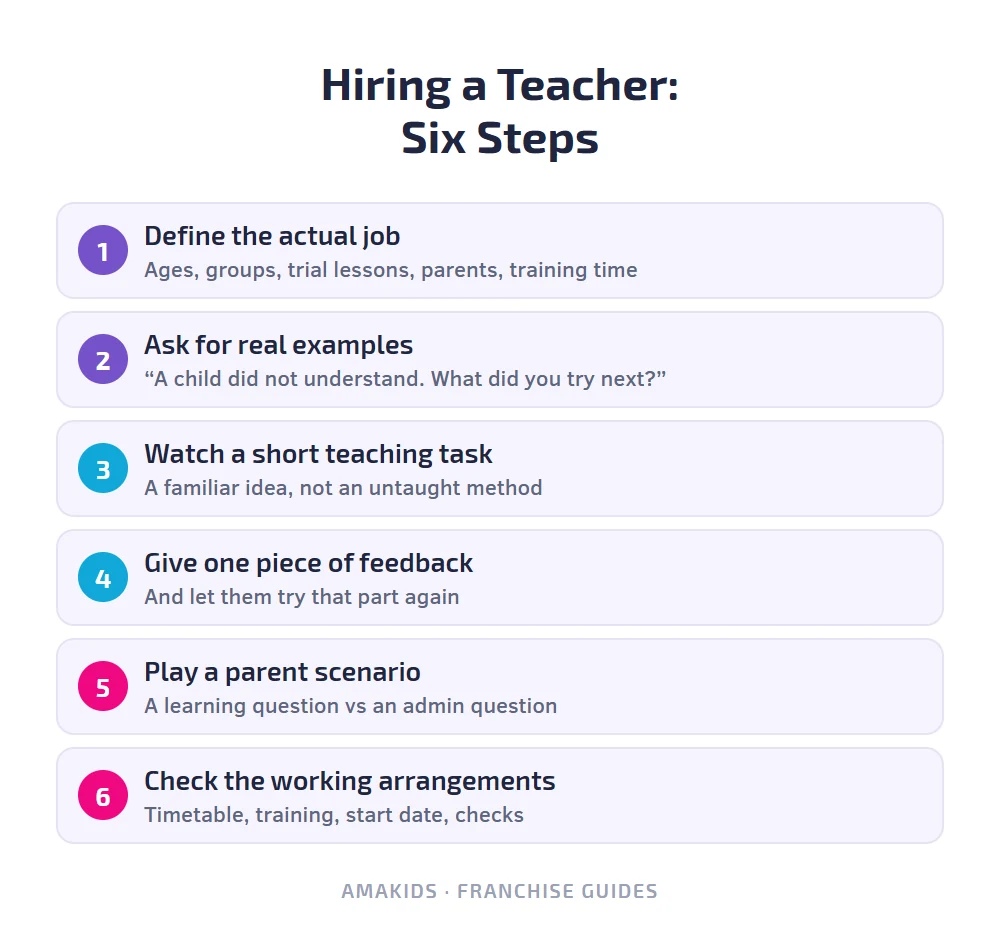
Define the actual job before reviewing candidates
“Teacher wanted for a children’s centre” leaves a lot open to interpretation.
Will the person teach existing groups or help launch new ones? Which ages will they work with? Does the role include trial lessons, checking home practice, recording progress or speaking with parents?
Clarify the teaching schedule and preparation responsibilities too. A candidate may be available during lesson hours but unable to attend the training needed before starting.
Write a short role description that reflects everyday work. Distinguish the qualifications and experience required at entry from the programme knowledge that will be taught during onboarding.
If you operate through a franchise, confirm its current teacher eligibility and training requirements before advertising. Your recruitment criteria should match the programme you intend to deliver.
Ask for examples that reveal how someone teaches
General questions invite general answers.
“Are you patient with children?” will probably produce a yes. Asking someone to describe a difficult teaching moment gives you more to assess.
Try questions such as:
- “Tell me about a time a child did not understand your explanation. What did you try next?”
- “How have you handled a group where some children finished much earlier than others?”
- “Describe feedback that led you to change something in your teaching.”
- “What do you do when you are unsure how to answer a parent’s question?”
Follow the example through. What did the candidate notice? What did they do? How did they decide whether it helped?
Candidates with limited classroom experience may draw on tutoring, supervised practice or other relevant work with children. Keep the distinction clear between something they have done and something they propose to do.
Specific answers make it easier to identify both strengths and areas that would need support.
Observe a short teaching task
A demonstration gives you another source of evidence.
Provide a clear brief, suitable materials and reasonable preparation time. Explain who will participate and what you want to observe. An adult role-play can be useful during initial selection, without involving children in an unfamiliar recruitment exercise.
Choose a task the candidate can reasonably prepare. Someone applying to learn a mental arithmetic methodology should not be expected to demonstrate an unfamiliar proprietary technique before receiving training.
You can still observe whether they explain a familiar idea clearly, invite participation and check understanding.
Pay attention to the interaction. Does the candidate allow someone time to think? Do they notice uncertainty? Can they respond calmly when an answer is incorrect?
An energetic presentation can be engaging, but leave space to see how the candidate listens.
See what happens after feedback
After the demonstration, ask the candidate what they thought went well and what they would change.
Then offer one specific observation. Perhaps an instruction contained several steps, and the participant was unsure where to begin. Ask how the candidate might simplify it and invite them to try that short section again.
This helps you assess how they work with feedback.
They may ask a useful clarifying question, explain their original reasoning or find a clearer approach. They may also struggle to make an adjustment. Each response gives you something concrete to discuss.
A teaching programme requires people to learn shared methods and use agreed resources. Their willingness to engage thoughtfully with guidance matters alongside their existing experience.
Keep this exercise proportionate. A brief recruitment task should give you evidence for a hiring decision; substantial training belongs in a properly arranged onboarding process.
Discuss parent communication and professional boundaries
Teachers often hear questions that extend beyond the lesson.
A parent may ask why their child is progressing differently from another student. They may request a timetable change, question a payment or raise a concern about behaviour.
Use a realistic scenario to explore how the candidate responds.
For a learning question, listen for a clear explanation grounded in what the teacher has observed. Can they describe a difficulty respectfully and suggest an appropriate next step without labelling the child?
For an administrative question, check whether they recognise when another team member should respond.
A teacher should know how to acknowledge a concern and pass it to the right person. Promising a refund, a different group or a particular learning result without authority can create problems for the whole centre.
Confirm that the working arrangements are realistic
Before making a decision, have a direct conversation about availability, preparation, training and the intended start date.
Explain how the timetable will work, including any gaps between classes. Clarify responsibilities outside teaching hours and how those responsibilities are reflected in the proposed arrangement.
Discuss how the candidate should report an absence and whom they can approach for support.
Where appropriate, verify relevant qualifications and references through the centre’s recruitment process. Complete the required suitability checks before assigning work with children.
These steps deserve attention even when a candidate makes an excellent impression. The centre needs someone who can fulfil the role consistently, and the candidate needs an accurate picture of the commitment.
Make a decision you can explain
Use the same core criteria when comparing candidates: relevant eligibility, teaching communication, response to feedback, professional judgement and practical availability.
Record brief observations rather than broad impressions. “Asked the participant to explain the task in their own words” tells you more than “good with people.”
If you lack teaching expertise, involve a qualified educator in assessing the demonstration. The owner can evaluate the operational fit while an appropriate specialist helps judge the teaching.
Once you select someone, set out what happens before they take responsibility for a group. Programme training, access to materials, supported practice and a readiness review should have a clear place in that plan.
Hiring begins a working relationship. A careful decision gives both the teacher and the centre a clearer starting point.
Once the teacher has accepted, continue with preparing a teacher for their first group.
If you are exploring an AMAkids partnership, contact the franchise team to discuss teacher requirements and the preparation available for your selected programmes and market.
Discuss Teacher Training with AMAkids →Considering an AMAkids franchise? Get the partnership presentation: formats, programs and launch support.
Get the presentation