How to Handle Missed Lessons at a Children’s Learning Centre
A parent messages on Friday evening: their daughter is ill and cannot attend tomorrow’s class. Could she join another group next week?
It sounds straightforward. But the other group may be studying a different topic, its classroom may already be full, and the teacher may need time to help the child catch up.
For a children’s learning centre, a missed lesson involves several decisions: what the family’s enrolment terms provide, what the child needs educationally, and what the team can realistically arrange.
A clear process helps staff respond with care and give parents an answer they can rely on.
Explain absence arrangements before families need them
Parents should hear about absence arrangements when they enrol. By the time a child becomes ill or a family’s plans change, they should know whom to contact and where to find the relevant information.
Keep the explanation short and practical. It should cover how to report an absence, any applicable notice requirements, and how requests for replacement lessons are handled.
The explanation must reflect the centre’s actual agreement with families. An administrator should not promise an individual replacement lesson if the enrolment terms provide a different arrangement.
Avoid vague assurances such as “We’ll always work something out.” A parent may reasonably understand that as a promise of a convenient replacement whenever their child misses a class.
Give staff wording that describes the available arrangements accurately and leaves room to check the child’s learning needs before confirming a solution.
Separate the scheduling question from the learning question
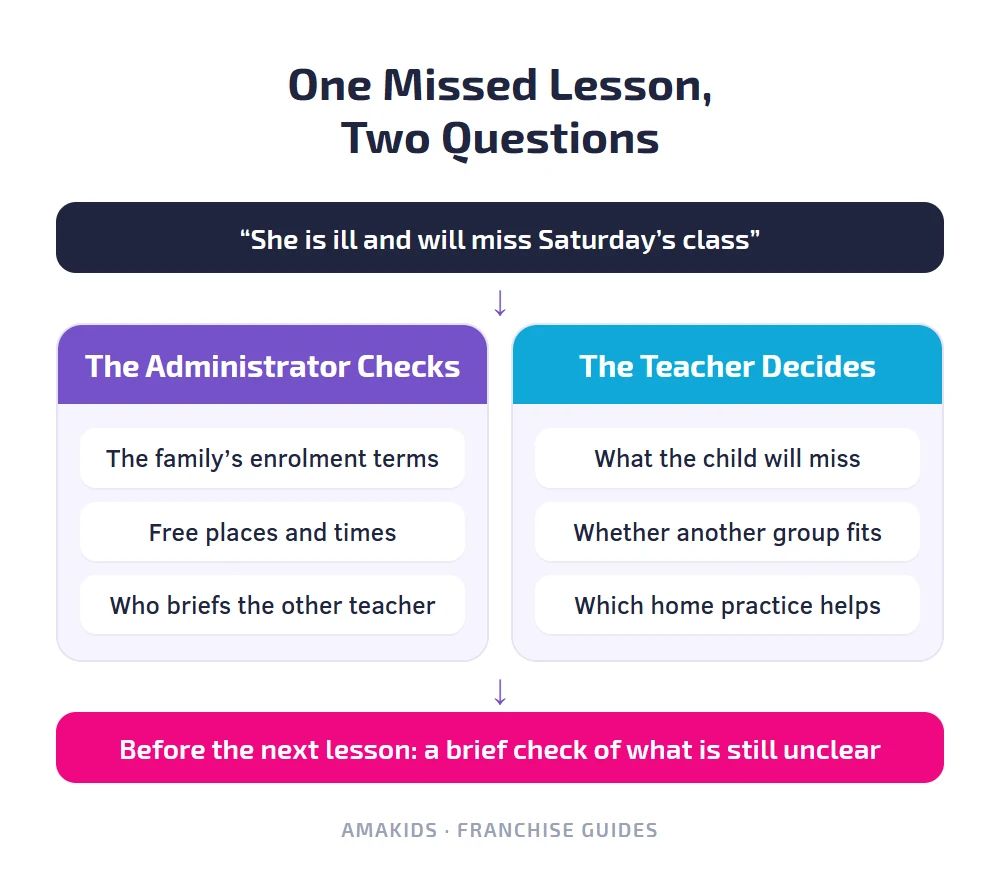
When a parent reports an absence, the first question is often about another date. The teacher needs to consider something else: what will the child miss?
These questions need different kinds of information.
The administrator can check the family’s arrangements, available places and possible times. The teacher can assess whether the missed material needs explanation and whether another group would be suitable.
Consider a hypothetical example. Two children miss the same class. One has already understood the relevant skill and needs further practice. The other was still having difficulty with the previous topic.
Offering both children the same worksheet may be convenient, but it does not establish that both are ready to continue.
A brief exchange between the teacher and administrator can prevent a scheduling decision from becoming an educational problem.
Check more than age before suggesting another group
Another class may have a spare seat and children of a similar age. That alone does not make it an appropriate replacement.
The teacher should check what that group is studying, what knowledge the activities assume, and whether the visiting child can take part meaningfully.
This matters in programmes such as mental arithmetic, where children of the same age may be working on different skills. It also applies to English and memory development: a matching age range does not necessarily mean matching preparation.
Before confirming a place, establish who will brief the receiving teacher and what they need to know.
A replacement lesson should have a clear purpose. Simply placing a child in an available classroom can leave the family believing that the missed learning has been covered when it has not.
Give home practice a specific purpose
Where a programme includes workbooks or digital practice, these resources may help a child maintain continuity during an absence.
The teacher should decide what is appropriate. Practice can reinforce something a child already understands. An unfamiliar task may require an explanation before independent work becomes useful.
A message saying “Please complete the next pages” leaves parents to judge whether their child should already know how to do them.
More helpful guidance identifies the relevant work, explains its purpose and tells the family what to do if the child struggles. Parents should also know which questions can wait until the child returns.
During illness, the immediate priority may simply be recovery. Any suggested practice should take the child’s situation into account, without turning an absence into a growing backlog of assignments.
Make the return to class part of the plan
The process is not finished when a replacement time is booked or a task is sent.
Before the child’s next regular lesson, the teacher should know what happened during the absence. Was any support arranged? Did the child complete familiar practice? Is something still unclear?
That information allows the teacher to check the relevant understanding and decide what support is needed.
The check can be brief and discreet. A returning child should be able to rejoin the group without being made to feel responsible for disrupting its progress.
For a longer absence, the teacher may need a more considered review before recommending how to resume. Avoid assuming that attendance at the next scheduled class automatically means the child is ready for everything the group has covered.
Notice when occasional absences become a pattern
One missed lesson rarely tells you much about a family’s commitment. Repeated absences deserve a conversation.
Start by understanding the practical difficulty. The class may now clash with a parent’s working hours. Transport may be unreliable. A child may be finding the lessons difficult, or the family may have taken on too many activities.
A useful opening is:
“We’ve noticed that attending this class has been difficult recently. Is the timing still workable for your family?”
The answer can guide the next step. A different available group might help with a scheduling problem. A teaching conversation may be more useful if the child feels overwhelmed.
Record only what the team needs to organise support and follow up. Teachers and administrators need relevant information, rather than a long history of private family circumstances.
Make commitments visible to the team
Small centres sometimes manage absences entirely through individual messages. That can work until someone forgets a promise, a teacher changes, or several families request replacement lessons at once.
Keep a shared record of the absence, the agreed action, who is responsible and whether it has been completed. Use the centre’s approved system so the relevant staff can find the information.
The owner can then see whether the arrangements are manageable. Are replacement sessions accumulating? Are teachers repeatedly providing unplanned extra time? Are families waiting too long for confirmation?
Those patterns may show that the process needs attention.
A workable approach gives parents clear information, helps teachers protect continuity and makes staff commitments realistic. Families should know what will happen next, and the team should be able to deliver it.
If you are considering opening an AMAkids centre, speak with the franchise team about the operating guidance and support available for your intended market.
Contact the AMAkids Franchise Team →Considering an AMAkids franchise? Get the partnership presentation: formats, programs and launch support.
Get the presentation