Why It’s Beneficial for Children to "Think Slower" Sometimes: The Hidden Effect of Mental Arithmetic
When parents first hear about mental arithmetic, the same image almost always comes to mind: a child lightning-fast at calculating large numbers. The speed is indeed impressive. But if you look closer at the lessons, it becomes clear that the method’s primary value lies elsewhere.
The paradox is that rapid calculation is built through the ability to occasionally… slow down.
When Speed Becomes a Hindrance
Modern children grow up in an intense information flow. Videos, games, short clips, and constant attention-switching. The brain becomes accustomed to reacting instantly: see — click — switch.
While this dynamic is convenient for entertainment, it often works against a child in academics. They begin to rush, failing to read problem statements fully and skipping details. Errors occur not because the topic is difficult, but due to haste.
Mental arithmetic gradually shifts this mode of operation.
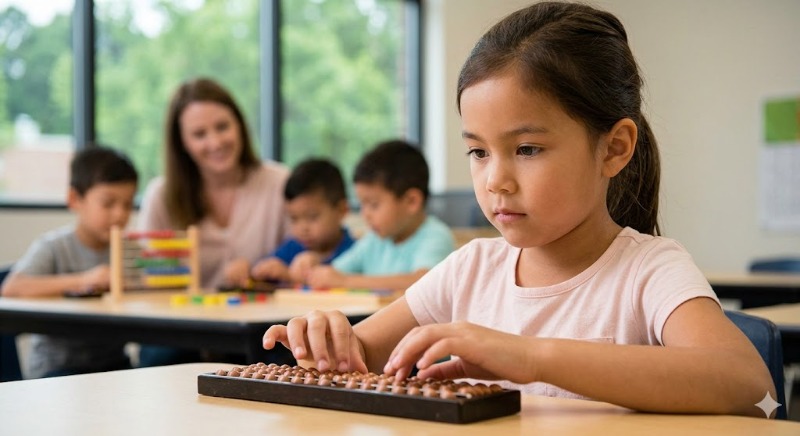
During lessons, a child learns to hold a sequence of actions in their mind. They must visualize the abacus, mentally move the beads, and monitor intermediate results. If they act impulsively, the calculation falls apart.
Gradually, a new habit of approaching tasks is formed:
-
First, visualize the structure of the action;
-
Maintain the sequence of operations;
-
Control the intermediate result;
-
Only then accelerate the pace of calculation.
As a result, the habit develops to first construct the action and only then speed up.
Attention Management
One of the most noticeable changes occurs specifically with concentration. During lessons, a child works at a fairly intense rhythm: tasks change quickly, yet they require absolute precision.
Initially, attention constantly "slips." This is normal; the brain isn't yet used to holding several processes simultaneously. Over time, the situation changes. Internal composure emerges—the ability to keep a task in focus a bit longer than before. Not through a forced "I must try harder" effort, but almost automatically.
Parents usually notice this outside of class. Homework begins to be completed more calmly, without constant distractions. They most frequently note several changes:
-
The child concentrates on a single task longer;
-
They are less distracted by external stimuli;
-
They return to the task faster after a break;
-
They react more calmly to difficult exercises.
Why Mistakes Become Useful
Another interesting effect is related to the attitude toward mistakes. In mental arithmetic, they are inevitable. Sometimes a child falters due to a single incorrect operation, and the entire chain of calculations collapses.
But it is at this exact moment that vital work happens. The child learns to return to the process, reconstruct the sequence of actions, and find where the inaccuracy occurred. This develops analytical thinking—the ability not just to get an answer, but to understand how it was derived.
Eventually, a calmer reaction to complex tasks develops. If it didn't work the first time, it simply means they need to figure out exactly where the glitch happened.
Implementation in AMAKids Programs
In AMAKids centers, lessons are structured so that the child gradually passes through several stages of skill development. Work begins with a physical abacus, and then the actions transition into an imaginary form—the mental calculation itself.
At each stage, the load increases very carefully. A sudden jump in difficulty leads to a loss of interest, so the program moves in "baby steps." The child becomes accustomed to a new level of tasks and only then moves forward.
The lesson structure usually includes several types of exercises:
-
Working with the abacus and basic operations;
-
Visualization exercises for mental counting;
-
Speed and concentration tasks;
-
Short blocks for checking attention.
Teachers monitor not only the correctness of the answer but also how the child navigates the process itself—how composed they are, how they react to difficult exercises, and whether they can sustain attention throughout the lesson.
The Result: Mental arithmetic functions not as a speed drill, but as a workout for the mind. The child begins to better control their own pace of work—and it is precisely this control that gradually makes them faster.
Leave a request for a free consultation
Get a consultation